VO2 Max is a key indicator of your body’s aerobic fitness, representing the maximum amount of oxygen your muscles can use during intense exercise.
It’s more than just a number for athletes—it’s a powerful measure of overall cardiovascular health and endurance.
As we age, VO2 Max naturally changes, influencing our stamina, energy levels, and even longevity.
Understanding how VO2 Max varies across different age groups can help you track your fitness, set realistic goals, and implement strategies to maintain or improve it.
While genetics play a role, lifestyle factors such as regular exercise, diet, and strength training can significantly impact VO2 Max at any stage of life.
In this article, we will explore average VO2 Max values by age and gender, examine the factors affecting it, and provide practical tips to optimize your aerobic fitness, helping you stay strong and active throughout your life.
What is VO2 Max?
VO2 Max, or maximal oxygen uptake, is a measure of how efficiently your body can take in, transport, and use oxygen during intense exercise. It reflects the combined function of your heart, lungs, blood, and muscles, making it one of the most reliable indicators of cardiovascular fitness. In simple terms, the higher your VO2 Max, the more oxygen your body can deliver to your muscles, and the better your endurance and overall athletic performance.
There are two main ways VO2 Max is expressed: absolute VO2 Max, measured in liters of oxygen per minute (L/min), and relative VO2 Max, measured in milliliters of oxygen per kilogram of body weight per minute (ml/kg/min). Relative VO2 Max is more commonly used because it accounts for differences in body size, allowing fair comparisons between individuals.
VO2 Max is not just for elite athletes—it’s a valuable health metric for everyone. Research shows that higher VO2 Max levels are linked to lower risk of heart disease, improved metabolism, and longer life expectancy. It can be measured accurately in a laboratory setting using treadmill or cycling tests with gas analysis, but there are also practical field tests like the Cooper 12-minute run, Rockport walk test, and modern wearables that estimate VO2 Max for everyday fitness tracking.
Understanding VO2 Max lays the foundation for recognizing how it changes with age and what you can do to maintain or improve it throughout life.
Average VO2 Max by Age
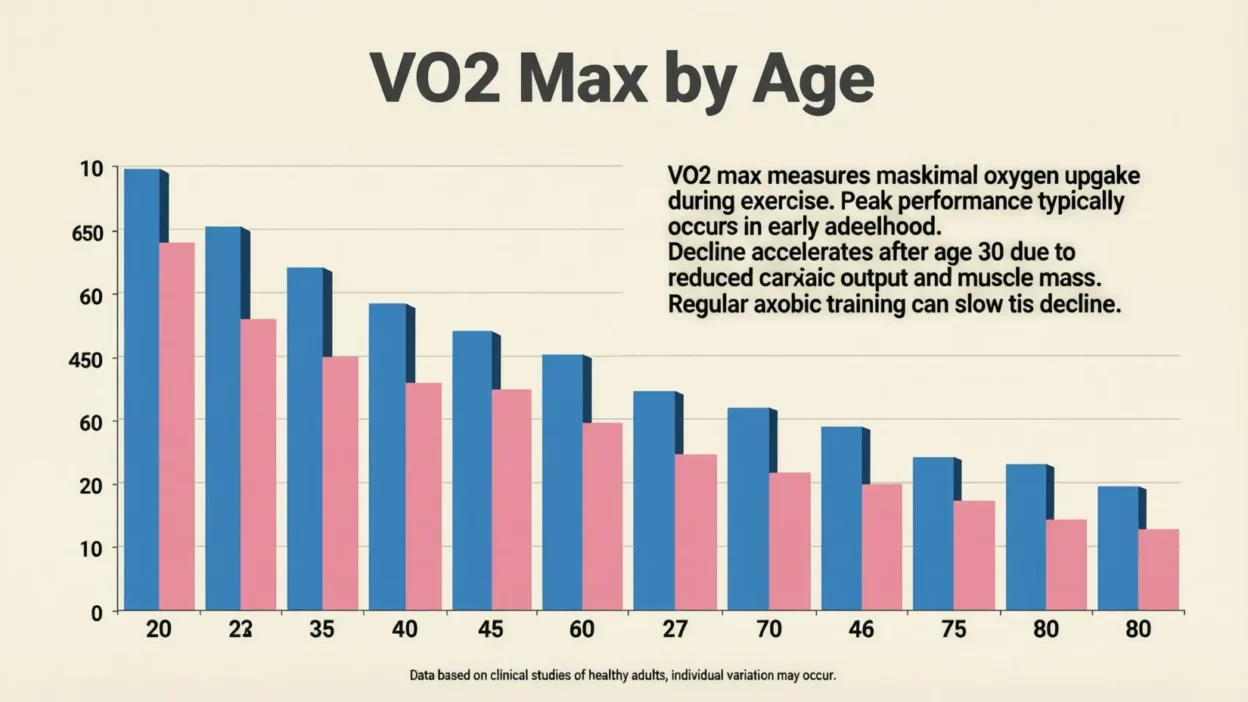
VO2 Max naturally changes as we age, reflecting both biological aging and lifestyle factors. On average, VO2 Max peaks in the late teens to early twenties and gradually declines by about 5–10% per decade after the age of 30. This decline is influenced by a reduction in maximum heart rate, decreased lung capacity, and loss of muscle mass.
For men, average VO2 Max values typically range as follows:
- 20–29 years: 40–50 ml/kg/min
- 30–39 years: 38–48 ml/kg/min
- 40–49 years: 35–45 ml/kg/min
- 50–59 years: 32–42 ml/kg/min
- 60–69 years: 28–38 ml/kg/min
- 70+ years: 25–35 ml/kg/min
For women, the averages are slightly lower due to physiological differences:
- 20–29 years: 35–45 ml/kg/min
- 30–39 years: 33–43 ml/kg/min
- 40–49 years: 30–40 ml/kg/min
- 50–59 years: 28–38 ml/kg/min
- 60–69 years: 25–35 ml/kg/min
- 70+ years: 22–32 ml/kg/min
These numbers serve as benchmarks to help individuals assess their aerobic fitness relative to their age group. It’s important to remember that genetics, activity level, and health conditions can create wide variations. While VO2 Max naturally declines with age, staying physically active, engaging in aerobic exercise, and maintaining a healthy lifestyle can slow this decline and, in some cases, even improve VO2 Max, regardless of age.
Understanding these averages allows you to set realistic goals and track your cardiovascular health over time, empowering better training and lifestyle decisions.
Factors That Affect VO2 Max
VO2 Max is influenced by a combination of biological, lifestyle, and environmental factors. While some elements, like genetics, are beyond our control, many can be managed to maintain or improve aerobic fitness.
1. Age and Gender:
VO2 Max naturally declines with age, largely due to a decrease in maximum heart rate, lung function, and muscle mass. Men generally have higher VO2 Max values than women because of differences in body composition, hemoglobin levels, and muscle mass.
2. Genetics:
Studies suggest that genetics account for approximately 20–40% of an individual’s VO2 Max. Some people are naturally predisposed to higher aerobic capacity, but training can still improve it significantly.
3. Physical Activity and Training:
Regular aerobic exercise is the most significant modifiable factor affecting VO2 Max. Endurance training, high-intensity interval training (HIIT), and even consistent recreational activity can boost oxygen utilization and slow age-related decline.
4. Body Composition:
Higher body fat percentages can lower relative VO2 Max, while maintaining lean muscle mass improves it.
5. Health Conditions:
Chronic illnesses, cardiovascular disease, respiratory disorders, and metabolic conditions can all negatively impact VO2 Max.
6. Lifestyle Factors:
Smoking, poor nutrition, inadequate sleep, and high stress levels can reduce aerobic capacity, whereas a healthy diet, proper hydration, and stress management support higher VO2 Max levels.
How VO2 Max Changes With Age
VO2 Max naturally declines as we grow older, a process influenced by both physiological changes and lifestyle factors. Typically, VO2 Max peaks in the late teens or early twenties and begins to decrease gradually at a rate of about 5–10% per decade after age 30. While this decline is normal, its pace can vary significantly depending on activity level, health status, and genetics.
Several physiological factors contribute to this decrease. Maximum heart rate diminishes with age, reducing the amount of blood—and therefore oxygen—the heart can pump during exercise. Lung function also declines, limiting oxygen intake and transfer to the bloodstream. Additionally, muscle mass and strength decrease over time, resulting in lower oxygen utilization by working muscles. Mitochondrial efficiency, which affects how muscles convert oxygen into energy, also diminishes with age.
Despite these natural declines, maintaining an active lifestyle can slow the reduction in VO2 Max. Studies show that older adults who engage in regular aerobic exercise often maintain levels comparable to sedentary individuals decades younger. For example, an active 60-year-old may have a VO2 Max similar to a sedentary 40-year-old. Conversely, a sedentary lifestyle accelerates the decline, leading to reduced stamina, energy, and cardiovascular health.
Understanding how VO2 Max changes with age empowers individuals to take proactive measures—through exercise, strength training, and healthy habits—to preserve aerobic capacity and maintain vitality throughout life.
How to Improve VO2 Max at Any Age
The good news is that VO2 Max isn’t fixed—people of all ages can improve their aerobic capacity with the right training and lifestyle choices. The key is to challenge the cardiovascular system consistently while supporting the body with proper recovery and nutrition.
1. Aerobic Exercise:
Traditional endurance activities like running, cycling, swimming, and rowing are highly effective. Steady-state cardio performed several times per week strengthens the heart, improves lung efficiency, and enhances oxygen delivery to muscles.
2. High-Intensity Interval Training (HIIT):
Short bursts of intense activity followed by recovery periods have been shown to significantly boost VO2 Max, even in older adults. HIIT enhances cardiovascular efficiency and increases the body’s ability to utilize oxygen.
3. Strength Training:
While not directly increasing VO2 Max, resistance training helps maintain and build muscle mass, which supports better oxygen utilization and overall metabolic health. Combining strength and aerobic training produces optimal results.
4. Lifestyle Factors:
Adequate sleep, balanced nutrition, hydration, and stress management all contribute to improved cardiovascular performance. Avoiding smoking and limiting alcohol also supports higher VO2 Max levels.
5. Monitoring Progress:
Using wearable devices, heart rate monitors, or field tests like the Cooper run or Rockport walk helps track improvements over time and tailor training intensity appropriately.
Why VO2 Max Matters Beyond Fitness
While VO2 Max is often associated with athletic performance, its significance extends far beyond exercise. It serves as a powerful indicator of overall health, longevity, and quality of life. Higher VO2 Max levels are linked to stronger cardiovascular function, lower risk of heart disease, and improved metabolic health. Individuals with higher aerobic capacity tend to have lower blood pressure, better cholesterol profiles, and reduced likelihood of developing type 2 diabetes.
VO2 Max also plays a role in longevity. Research shows that adults with higher VO2 Max scores generally live longer than their peers with lower scores. This is because the body’s ability to efficiently deliver and utilize oxygen affects multiple systems, including the heart, lungs, and muscles, which all contribute to overall resilience and vitality.
Beyond physical health, VO2 Max impacts daily energy and functional capacity. People with higher aerobic fitness find it easier to perform routine activities, recover from physical exertion, and maintain independence as they age. Mental health may also benefit, as improved cardiovascular function enhances blood flow and oxygen delivery to the brain, supporting cognition, focus, and mood.
In essence, VO2 Max is not just about running faster or cycling longer—it is a holistic measure of your body’s efficiency, endurance, and ability to thrive. Tracking and improving VO2 Max through exercise and healthy habits can lead to better long-term health outcomes, making it a key metric for anyone interested in fitness, aging well, and maximizing overall wellness.
VO2 Max Tests You Can Try
Measuring VO2 Max is an essential step to understanding your cardiovascular fitness. While laboratory tests are the most accurate, there are several practical options for people of all ages and fitness levels.
1. Lab-Based Tests:
The gold standard involves a treadmill or cycle ergometer test in a controlled environment, often with a mask to measure oxygen intake and carbon dioxide output. These tests provide precise VO2 Max values but require specialized equipment and supervision by trained professionals.
2. Field Tests:
For those without access to a lab, field tests offer reliable estimates. Popular options include the Cooper 12-Minute Run, where you run as far as possible in 12 minutes, and the Rockport Walk Test, suitable for beginners or older adults. The beep test, often used in sports settings, is another practical way to measure aerobic capacity. These tests estimate VO2 Max based on distance covered or performance metrics.
3. Wearable Technology:
Modern fitness trackers and smartwatches can estimate VO2 Max by analyzing heart rate, pace, and activity data during workouts. While less precise than lab tests, they provide continuous feedback and allow you to track progress over time conveniently.
VO2 Max Benchmarks by Age
Understanding VO2 Max benchmarks can help you evaluate your aerobic fitness and set realistic goals for improvement. These benchmarks categorize VO2 Max into levels ranging from poor to superior, adjusted for age and gender.
For men, typical relative VO2 Max classifications are:
- 20–29 years: Poor <35, Average 35–43, Good 44–52, Excellent 53–60, Superior >60 ml/kg/min
- 30–39 years: Poor <33, Average 33–41, Good 42–50, Excellent 51–58, Superior >58 ml/kg/min
- 40–49 years: Poor <31, Average 31–39, Good 40–48, Excellent 49–55, Superior >55 ml/kg/min
- 50–59 years: Poor <28, Average 28–36, Good 37–44, Excellent 45–51, Superior >51 ml/kg/min
- 60+ years: Poor <25, Average 25–33, Good 34–41, Excellent 42–48, Superior >48 ml/kg/min
For women, the ranges are slightly lower due to physiological differences:
- 20–29 years: Poor <27, Average 27–34, Good 35–42, Excellent 43–49, Superior >49 ml/kg/min
- 30–39 years: Poor <26, Average 26–33, Good 34–41, Excellent 42–47, Superior >47 ml/kg/min
- 40–49 years: Poor <24, Average 24–31, Good 32–38, Excellent 39–45, Superior >45 ml/kg/min
- 50–59 years: Poor <22, Average 22–29, Good 30–36, Excellent 37–42, Superior >42 ml/kg/min
- 60+ years: Poor <20, Average 20–27, Good 28–34, Excellent 35–39, Superior >39 ml/kg/min
These benchmarks help you gauge whether your aerobic fitness is below, at, or above average for your age. While genetics and lifestyle factors influence your VO2 Max, staying active and engaging in regular aerobic training can help you move into higher categories, improving endurance, cardiovascular health, and overall quality of life.
Common Myths About VO2 Max
Despite being a widely recognized fitness metric, VO2 Max is surrounded by misconceptions. Understanding the truth behind these myths can help you make better decisions for your health and training.
Myth 1: VO2 Max Cannot Improve After a Certain Age
Many people believe that VO2 Max inevitably declines and cannot be improved in older adults. While VO2 Max does naturally decrease with age, research shows that regular aerobic exercise and high-intensity interval training (HIIT) can significantly increase VO2 Max at any age, even into the 60s and 70s.
Myth 2: Only Elite Athletes Can Benefit From VO2 Max Training
VO2 Max is often associated with professional athletes, but it is relevant for everyone. Improving VO2 Max enhances cardiovascular health, stamina, and overall quality of life, making it beneficial for recreational exercisers, older people, and beginners alike.
Myth 3: VO2 Max is Only About Running or Cycling
While running and cycling are common ways to improve VO2 Max, any aerobic activity that challenges your heart and lungs—such as swimming, rowing, dancing, or even brisk walking—can be effective. Consistency and intensity matter more than the specific exercise.
Myth 4: Genetics Completely Determine VO2 Max
Genetics influence baseline VO2 Max, but lifestyle and training can account for substantial improvements. Sedentary individuals can increase their VO2 Max by 10–20% or more with proper training.
Tracking Progress Over Time
Monitoring VO2 Max over time is essential for understanding your cardiovascular fitness, setting realistic goals, and evaluating the effectiveness of your training routine. Tracking progress allows you to see improvements, identify plateaus, and make adjustments to optimize performance and health.
1. Regular Testing:
Consistent testing, whether through lab assessments, field tests, or wearable technology, helps track changes in VO2 Max. Lab tests provide the most accurate measurements, while field tests like the Cooper 12-minute run or Rockport walk test offer practical alternatives. Wearables provide ongoing estimates that are convenient for daily or weekly tracking.
2. Set Measurable Goals:
Establishing short-term and long-term goals keeps you motivated. For example, aiming to improve your VO2 Max by a specific amount over three months provides a clear benchmark for progress.
3. Analyze Trends, Not Single Results:
VO2 Max can fluctuate due to factors like fatigue, illness, or hydration. Focus on long-term trends rather than individual test results to get an accurate picture of fitness improvements.
4. Combine Metrics:
Track VO2 Max alongside other indicators, such as resting heart rate, workout performance, and body composition, for a more comprehensive view of cardiovascular health.
5. Adjust Training Accordingly:
Use your VO2 Max trends to tailor exercise intensity, duration, and type. If progress stalls, incorporating high-intensity intervals, strength training, or additional aerobic sessions can help.
Frequently Asked Questions (FAQs)
1. What is a good VO2 Max for my age?
A good VO2 Max depends on age, gender, and activity level. Generally, “average” values decline with age. For men, a relative VO2 Max of 35–43 ml/kg/min is average in the 20s, while for women it’s 27–34 ml/kg/min. Superior levels are typically 55+ for men and 49+ for women in the same age group.
2. Can VO2 Max improve naturally without training?
VO2 Max is influenced by genetics, but without exercise, it will gradually decline with age. While lifestyle factors like diet and avoiding smoking help, consistent aerobic activity is necessary for meaningful improvement.
3. How quickly does VO2 Max decline with age?
On average, VO2 Max declines about 5–10% per decade after age 30. Sedentary lifestyles accelerate this decline, while active individuals maintain higher levels and may experience minimal decreases.
4. Which exercises are best for improving VO2 Max?
Endurance exercises like running, cycling, swimming, and rowing are effective. High-intensity interval training (HIIT) can produce faster improvements, even for older adults. Combining aerobic workouts with strength training supports better oxygen utilization.
5. How often should I test my VO2 Max?
Testing every 2–3 months is generally sufficient to track meaningful changes, though more frequent monitoring with wearables can help guide training adjustments. Focus on long-term trends rather than single measurements.
6. Can older people improve VO2 Max?
Absolutely. Studies show that older adults, even in their 60s and 70s, can increase VO2 Max with consistent aerobic and interval training. Maintaining physical activity is key to slowing age-related decline.
These FAQs help clarify common concerns and provide practical advice for readers of all ages looking to understand or improve their VO2 Max.
Conclusion:
VO2 Max is more than just a fitness metric—it is a window into your cardiovascular health, endurance, and overall quality of life.
Understanding how VO2 Max changes with age allows you to track your fitness, identify areas for improvement, and make informed decisions about exercise and lifestyle.
While it naturally declines over time, the rate of decrease is highly influenced by activity level, genetics, and healthy habits.
Regular aerobic exercise, high-intensity interval training, and strength training are powerful tools to maintain or even improve VO2 Max at any age.
Maintaining a healthy VO2 Max contributes to better stamina, energy, and functional capacity, making everyday activities easier and more enjoyable.
It also supports long-term health by reducing the risk of cardiovascular disease, improving metabolic function, and enhancing cognitive performance.
Tracking VO2 Max through lab tests, field assessments, or wearable technology provides valuable feedback, allowing you to set realistic goals and monitor your progress over time.
Ultimately, VO2 Max is not just about athletic performance—it is a measure of how efficiently your body uses oxygen, which affects virtually every aspect of your health.
By understanding your VO2 Max, staying active, and adopting a healthy lifestyle, you can maintain cardiovascular fitness, delay age related decline, and enjoy a higher quality of life for years to come. Every step, sprint, or swim contributes to a stronger, healthier you

Jonathan Bishopson is the punmaster-in-chief at ThinkPun.com, where wordplay meets wit and every phrase gets a clever twist. Known for turning ordinary language into laugh-out-loud lines, Jonathan crafts puns that make readers groan, grin, and think twice. When he’s not busy bending words, he’s probably plotting his next “pun-derful” masterpiece or proving that humor really is the best re-word.