
Choosing the right Social Security retirement age is one of the most important financial decisions you will make in retirement.
The age at which you begin claiming benefits can significantly affect your monthly income, lifetime payout, and overall financial security.
Yet many people misunderstand how Social Security works, assuming that full retirement age means maximum benefits or that claiming as early as possible is always the best option.
In reality, Social Security retirement age rules are more nuanced. Benefits can be claimed as early as age 62 or delayed until age 70, with permanent reductions or increases depending on when you file.
Factors such as health, life expectancy, employment status, taxes, and spousal benefits all play a role in determining the best claiming strategy.
This guide breaks down everything you need to know about Social Security retirement age so you can make an informed, confident decision that aligns with your long-term retirement goals.
Understanding Social Security Basics
Social Security is a federal program designed to provide a foundational source of income for retirees, disabled workers, and surviving family members. For retirement purposes, it serves as a lifelong monthly benefit intended to replace a portion of your pre-retirement earnings—not your entire income. Understanding how the program works is essential before deciding when to claim benefits.
Social Security is funded primarily through payroll taxes collected under the Federal Insurance Contributions Act (FICA). Employees and employers each contribute a percentage of wages, while self-employed individuals pay both portions. These contributions earn workers Social Security credits, with most people needing 40 credits (roughly 10 years of work) to qualify for retirement benefits.
The amount you receive in retirement is based on your earnings history. The Social Security Administration calculates benefits using your highest 35 years of inflation-adjusted earnings. If you worked fewer than 35 years, zero-income years are included, which can lower your benefit amount.
It’s also important to distinguish retirement benefits from other Social Security programs. Disability benefits support workers who can no longer work due to qualifying medical conditions, while survivor benefits provide income to spouses and dependents after a worker’s death.
While Social Security plays a critical role in retirement planning, it is designed to supplement—not replace—personal savings, pensions, and other retirement income sources.
What Is Full Retirement Age (FRA)?
Full Retirement Age (FRA) is the age at which you are entitled to receive your full Social Security retirement benefit without any permanent reduction for early claiming. It serves as a critical benchmark in Social Security planning, but it is often misunderstood. Importantly, full retirement age does not mean the maximum benefit—it simply means the amount you qualify for based on your earnings record.
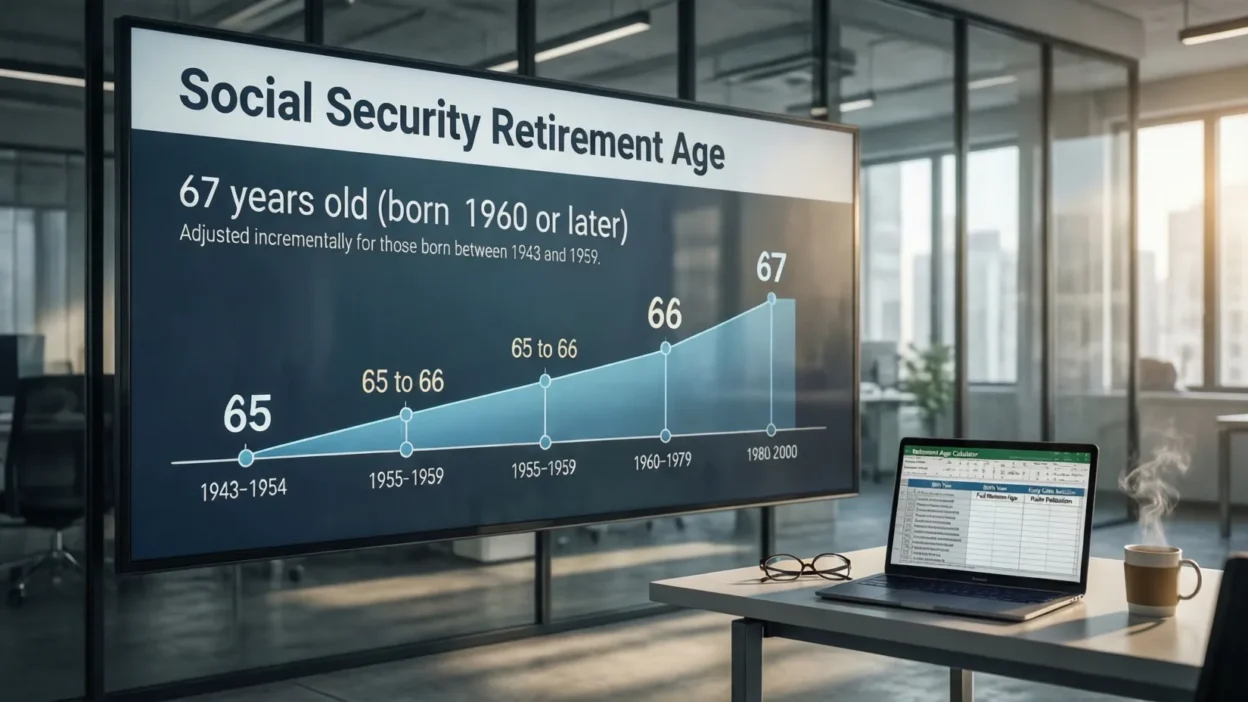
Your full retirement age depends on your year of birth. For individuals born between 1943 and 1954, FRA is age 66. For those born after 1954, full retirement age gradually increases, reaching age 67 for anyone born in 1960 or later. This change reflects legislative adjustments made to account for longer life expectancies and the long-term sustainability of the Social Security program.
Claiming benefits at your full retirement age allows you to avoid early filing penalties, but delaying beyond FRA can increase your monthly benefit through delayed retirement credits. These credits add approximately 8% per year for each year you wait, up to age 70.
Understanding your full retirement age is essential because it affects benefit calculations, spousal benefits, earnings limits while working, and tax planning. Knowing where FRA fits into your overall retirement strategy helps you evaluate whether claiming early, at FRA, or later best aligns with your financial needs, health considerations, and long-term income goals.
Early Retirement Age (Age 62)
Age 62 is the earliest point at which most people can begin collecting Social Security retirement benefits. While claiming at 62 may seem appealing—especially if you need income or want to stop working—it comes with important trade-offs that should be carefully considered.
When you claim Social Security before your full retirement age, your benefits are permanently reduced. The reduction is based on how many months early you file. For someone whose full retirement age is 67, claiming at 62 can reduce monthly benefits by as much as 30%. This lower amount lasts for the rest of your life, even after reaching full retirement age.
Despite the reduction, early claiming can make sense in certain situations. Individuals with health concerns, shorter life expectancy, limited savings, or immediate income needs may benefit from starting payments sooner. Early benefits can also provide stability during job loss or career transitions later in life.
However, claiming at 62 has downsides beyond the reduced monthly benefit. If you continue working before reaching full retirement age, your benefits may be temporarily withheld if your earnings exceed annual limits set by the Social Security Administration. Additionally, lower benefits can increase the risk of financial strain later in retirement, particularly as healthcare costs rise.
Choosing to claim at 62 should be a strategic decision based on health, finances, employment status, and long-term retirement planning—not simply the desire to start benefits as soon as possible.
Delayed Retirement Age (Up to Age 70)
Delaying Social Security retirement benefits beyond your full retirement age can significantly increase your monthly income. For each year you postpone claiming after FRA, you earn delayed retirement credits, which boost your benefit by approximately 8% per year until age 70. After age 70, benefits no longer increase, making that the maximum claiming age for Social Security.
The primary advantage of delaying benefits is a higher guaranteed monthly payment for life. This can provide greater financial security, especially for individuals who expect to live longer, have a family history of longevity, or want to protect against the risk of outliving their savings. Higher benefits can also help offset inflation and rising healthcare costs in later retirement years.
Delaying Social Security often works best for people who continue working, have sufficient savings, or receive income from pensions or retirement accounts. Because there is no earnings limit once you reach full retirement age, you can work and earn unlimited income without reducing your benefits if you delay claiming.
However, delaying is not the right choice for everyone. It requires forgoing benefits in the short term, which may not be feasible for those with health issues, limited savings, or immediate income needs. There is also a “break-even” age—typically in your late 70s or early 80s—when total lifetime benefits from delaying begin to exceed those of early claiming.
Ultimately, delaying Social Security is a longevity and income-protection strategy that should be evaluated alongside your overall retirement plan.
How Retirement Age Affects Monthly Benefits
Your Social Security retirement age has a direct and lasting impact on how much you receive each month. Benefits are calculated using a formula based on your average indexed monthly earnings (AIME), which reflects your highest 35 years of inflation-adjusted earnings. This calculation produces your primary insurance amount (PIA)—the monthly benefit you receive if you claim at your full retirement age.
Claiming benefits before full retirement age reduces your monthly payment, while claiming after FRA increases it. For example, someone with a PIA of $2,000 per month at full retirement age might receive around $1,400 if they claim at 62, or roughly $2,480 if they delay until age 70. These adjustments are permanent and apply for the rest of your life.
The impact of claiming age goes beyond monthly income. A higher benefit can provide greater protection against longevity risk—the possibility of outliving your savings. It can also result in higher cost-of-living adjustments (COLAs) over time, since COLAs are calculated as a percentage of your benefit amount.
It’s also important to consider lifetime benefits, not just monthly payments. While claiming early results in more checks over time, delaying can produce a higher total payout if you live beyond your break-even age. This makes retirement age a critical factor in long-term planning.
Understanding how retirement age affects monthly benefits helps you weigh immediate income needs against long-term financial security and make a more informed Social Security claiming decision.
Working While Receiving Social Security
Many people choose to continue working while collecting Social Security, but the rules depend largely on your age. If you begin receiving benefits before reaching full retirement age, your earnings may temporarily reduce your Social Security payments due to the earnings test.
Under this rule, the Social Security Administration sets an annual earnings limit. If your income exceeds that limit, a portion of your benefits is withheld—typically $1 for every $2 earned above the threshold. In the year you reach full retirement age, a higher earnings limit applies, and benefits are reduced at a lower rate until the month you reach FRA.
Once you reach full retirement age, the earnings test no longer applies. You can work and earn unlimited income without any reduction in your Social Security benefits. Importantly, benefits withheld due to the earnings test are not lost. After reaching FRA, your monthly benefit is recalculated to account for previously withheld amounts, potentially increasing future payments.
Working while receiving Social Security can also affect your benefit amount positively. If your current earnings are higher than one of the years used in your original 35-year earnings calculation, Social Security may adjust your benefit upward.
However, working while collecting benefits can have tax implications. Wages combined with Social Security income may cause a portion of your benefits to become taxable.
Understanding these rules helps you avoid surprises and integrate work income strategically into your retirement plan while maximizing long-term benefits.
Taxes and Social Security Benefits
Many retirees are surprised to learn that Social Security benefits may be taxable, depending on your total income and filing status. The taxation of benefits is based on your combined income, which includes adjusted gross income, nontaxable interest, and one-half of your Social Security benefits.
If your combined income exceeds certain thresholds, up to 50% or 85% of your Social Security benefits may be subject to federal income tax. These thresholds vary depending on whether you file as an individual, married filing jointly, or married filing separately. While Social Security benefits themselves are not taxed at 85%, that portion becomes part of your taxable income and is taxed at your regular income tax rate.
Retirement age can influence how much of your benefits are taxed. Claiming Social Security early while continuing to work or withdrawing heavily from retirement accounts can increase your combined income, triggering higher taxation. Conversely, delaying benefits may allow for more strategic tax planning, such as converting traditional retirement accounts to Roth accounts or managing withdrawals more efficiently.
State taxation is another consideration. Some states tax Social Security benefits, while others fully or partially exempt them. Understanding your state’s tax rules is important when evaluating where and when to retire.
Effective tax planning can help reduce the tax burden on Social Security benefits. Strategies may include spreading out retirement account withdrawals, coordinating spousal benefits, and timing Social Security claims to minimize taxable income over your retirement years.
Spousal and Survivor Benefits & Retirement Age
Social Security retirement age plays a crucial role not only in your own benefits but also in spousal and survivor benefits, making it especially important for married, divorced, or widowed individuals. Understanding these rules can help couples coordinate claiming strategies and maximize total household income.
Spousal benefits allow a current or former spouse to receive up to 50% of the other spouse’s full retirement age benefit, provided certain conditions are met. To receive the maximum spousal benefit, the claiming spouse must wait until their own full retirement age. Claiming spousal benefits earlier results in a permanent reduction, even if the higher-earning spouse delays their own benefits.
Retirement age is even more critical when it comes to survivor benefits. A surviving spouse may be eligible to receive up to 100% of the deceased worker’s benefit, depending on the age at which survivor benefits are claimed. Claiming survivor benefits before the survivor’s full retirement age can reduce the monthly amount, while waiting can increase it up to the survivor FRA (not age 70).
Divorced spouses may also qualify for spousal or survivor benefits if the marriage lasted at least 10 years and the claimant is unmarried at the time of filing. Importantly, claiming benefits on an ex-spouse’s record does not reduce the ex-spouse’s benefits.
Because spousal and survivor benefits are closely tied to retirement age decisions, coordinating strategies—especially when one spouse has significantly higher earnings—can provide substantial long-term financial protection.
Health, Longevity, and Retirement Age Decisions
Health and life expectancy are among the most personal—and most important—factors in deciding when to claim Social Security. Because Social Security is designed to provide lifetime income, the length of time you expect to receive benefits can greatly influence whether claiming early or delaying makes financial sense.
Individuals in good health with a family history of longevity often benefit from delaying Social Security. Higher monthly payments can provide greater income in later years, when healthcare and long-term care costs tend to rise. Delaying benefits can also serve as a form of longevity insurance, protecting against the risk of outliving savings.
Conversely, those with serious health concerns or shorter life expectancy may find that claiming earlier provides more value. Receiving benefits sooner can help cover immediate expenses and ensure you collect income while you are able to enjoy it. In these cases, the reduced monthly benefit may be less of a concern.
The concept of a break-even age is often used in this decision. This is the age at which the total amount received from delaying benefits equals the total received from claiming earlier. While useful, break-even analysis should not be the sole decision factor, as it does not account for risk, inflation, or survivor benefits.
Ultimately, retirement age decisions should balance financial optimization with quality of life, personal health, and peace of mind—factors that are just as important as maximizing dollars.
Retirement Age vs. Financial Readiness
Your Social Security retirement age does not have to align perfectly with the age at which you stop working. Many people retire from full-time employment before claiming Social Security, while others continue working well after benefits begin. The key consideration is financial readiness, not just age.
Financial readiness means having enough income sources to support your lifestyle throughout retirement. Social Security is only one piece of the puzzle, alongside personal savings, employer-sponsored retirement plans, pensions, and Individual Retirement Accounts (IRAs). Claiming Social Security too early without sufficient savings can increase the risk of running out of money later in life.
For some retirees, delaying Social Security allows their retirement savings more time to grow or reduces early withdrawals, which can help manage sequence-of-returns risk—the danger of poor market performance early in retirement. Higher guaranteed Social Security income later can also reduce reliance on investment withdrawals during market downturns.
On the other hand, individuals with strong pensions or substantial savings may have more flexibility in choosing when to claim. In these cases, Social Security can be strategically delayed to maximize lifetime income or coordinated with required minimum distributions from retirement accounts.
Expenses also play a major role in readiness. Healthcare costs, housing, inflation, and lifestyle goals should all be factored into the decision. A realistic budget can help determine whether delaying Social Security is feasible or whether earlier benefits are necessary.
Aligning retirement age with financial readiness helps ensure that Social Security supports long-term stability rather than short-term convenience.
Common Social Security Retirement Age Myths
Misinformation about Social Security retirement age often leads people to make costly decisions. One common myth is that full retirement age means you receive the maximum benefit. In reality, benefits continue to increase beyond FRA if you delay claiming, up to age 70, through delayed retirement credits.
Another widespread belief is that you should always claim Social Security as early as possible to “get your money back.” While early claiming can make sense for some, it results in permanently reduced benefits and may increase financial strain later in life, especially for those who live longer than expected.
Many people also think that working while collecting Social Security causes them to lose benefits permanently. In truth, benefits withheld due to the earnings test before full retirement age are later credited back in the form of higher monthly payments after FRA.
There is also concern that Social Security is going bankrupt, leading some to claim early out of fear. While the program faces funding challenges, it is not disappearing, and current retirees and near-retirees are expected to receive benefits, even if future adjustments occur.
Finally, some believe that claiming Social Security early affects Medicare eligibility. Medicare eligibility is based on age 65, regardless of when you claim Social Security retirement benefits.
Separating fact from fiction helps you make confident, informed decisions and avoid unnecessary mistakes when choosing your retirement age.
Strategies for Choosing the Right Retirement Age
There is no single “best” Social Security retirement age, because the right choice depends on your personal, financial, and family circumstances. However, several proven strategies can help you make a more informed decision.
For single retirees, the decision often centers on health, longevity, and income needs. Those in good health with sufficient savings may benefit from delaying benefits to secure higher guaranteed income later in life. Individuals with limited savings or health concerns may prioritize earlier access to benefits for financial stability.
For married couples, coordination is especially important. A common strategy is for the higher-earning spouse to delay benefits as long as possible, increasing the future survivor benefit for the lower-earning spouse. Meanwhile, the lower-earning spouse may claim earlier to provide household income. This approach can maximize lifetime and survivor benefits.
Income level also matters. Higher earners generally benefit more from delaying Social Security because delayed retirement credits apply to a larger base benefit. Lower earners, who may rely more heavily on Social Security for basic expenses, may prioritize earlier claiming.
Health insurance coverage is another factor. Retiring before age 65 may require bridging healthcare costs until Medicare eligibility, which can influence when benefits are needed.
Finally, consider Social Security as longevity insurance—a stable, inflation-adjusted income stream that becomes more valuable the longer you live. Viewing Social Security strategically, rather than emotionally or out of fear, can help you choose a retirement age that supports both short-term needs and long-term financial security.
Recent and Potential Future Changes to Retirement Age
Social Security retirement age has changed before, and future adjustments remain a topic of ongoing debate. Understanding these potential changes can help you plan more confidently, especially if you are still years away from retirement.
Historically, full retirement age was set at 65. Amendments passed in 1983 gradually increased FRA to reflect longer life expectancies and improve the program’s financial sustainability. As a result, full retirement age now reaches 67 for individuals born in 1960 or later.
Today, policymakers continue to discuss possible reforms to address long-term funding challenges. One frequently proposed change is raising the full retirement age further, potentially to 68 or 69 for future retirees. Other proposals include adjusting benefit formulas, increasing payroll taxes, or modifying cost-of-living adjustments. These discussions are complex and politically sensitive, and no single proposal has been adopted.
For those nearing retirement, changes are unlikely to be sudden or retroactive. Historically, Social Security reforms have included long phase-in periods to protect current retirees and individuals close to retirement age. Younger workers, however, may experience more significant changes over time.
Given this uncertainty, flexibility is key. Building personal savings, diversifying income sources, and avoiding overreliance on Social Security can help reduce the impact of future policy changes. While Social Security remains a critical pillar of retirement income, proactive planning ensures you are prepared regardless of how retirement age rules evolve.
Tools and Resources to Help You Decide
Choosing the right Social Security retirement age can feel overwhelming, but several reliable tools and resources can help you make a more informed decision. The most important starting point is your Social Security Statement, available through your account on the Social Security Administration’s website. This statement provides personalized benefit estimates at different claiming ages based on your actual earnings history.
Online Social Security calculators are another valuable resource. These tools allow you to model different claiming scenarios—such as claiming early, at full retirement age, or delaying until age 70—and compare monthly and lifetime benefits. Some calculators also factor in spousal benefits, inflation, and life expectancy, helping you see how small changes in timing can have a large financial impact.
For more advanced planning, retirement income planning software or spreadsheets can help coordinate Social Security with pensions, IRAs, and other investment accounts. These tools are particularly helpful for evaluating tax strategies, withdrawal timing, and cash-flow needs throughout retirement.
In many cases, working with a financial advisor can provide additional clarity. A qualified advisor can help assess how Social Security fits into your broader retirement plan, taking into account taxes, healthcare costs, longevity risk, and market uncertainty. Advisors can also help couples coordinate claiming strategies to maximize lifetime and survivor benefits.
Using the right tools and professional guidance allows you to move beyond guesswork and make Social Security retirement age decisions based on data, strategy, and long-term confidence.
Frequently Asked Questions (FAQ)
What is the best age to collect Social Security?
There is no universal “best” age to collect Social Security. The ideal claiming age depends on factors such as health, life expectancy, income needs, marital status, and overall retirement savings. Some people benefit from claiming early at 62, while others gain more by delaying until full retirement age or age 70.
Can I change my mind after claiming Social Security?
In limited cases, yes. Within 12 months of claiming, you can withdraw your application and repay all benefits received. After that window, you may be able to suspend benefits at full retirement age to earn delayed retirement credits, though past reductions generally remain.
What happens if I claim early and keep working?
If you claim benefits before full retirement age and earn more than the annual earnings limit, some benefits may be temporarily withheld. These benefits are not lost and are later factored back into your payments after you reach FRA.
Does retirement age affect Medicare?
No. Medicare eligibility begins at age 65, regardless of when you claim Social Security retirement benefits. However, claiming Social Security does not automatically enroll you in Medicare unless you are already 65.
What if I don’t have enough work credits?
If you do not qualify based on your own work record, you may still be eligible for spousal or survivor benefits based on a current or former spouse’s earnings history.
Conclusion:
Deciding when to claim Social Security is one of the most consequential choices you will make in retirement.
Your Social Security retirement age affects not only your monthly benefit but also your long-term financial security, tax exposure, and ability to manage healthcare and living expenses later in life.
Claiming too early can permanently reduce income, while delaying may significantly increase lifetime benefits for those who live longer.
As this guide has shown, there is no one-size-fits-all solution. The right claiming age depends on a combination of factors, including health, longevity expectations, employment status, marital situation, and overall financial readiness.
Understanding how full retirement age, early claiming, delayed retirement credits, taxes, and spousal benefits work together allows you to evaluate your options more clearly.
Social Security should be viewed as part of a broader retirement strategy—not a standalone decision.
Coordinating benefits with personal savings, pensions, and retirement accounts can help create a more stable and predictable income stream throughout retirement.
While future policy changes may occur, informed planning and flexibility can reduce uncertainty.
By taking the time to understand Social Security retirement age rules and applying them thoughtfully to your personal situation, you can make confident decisions that support both your financial well-being and peace of mind throughout retirement.