
Social Security plays a critical role in retirement income for millions of Americans, and even small changes to its rules can have a major financial impact.
One of the most important—and often misunderstood—changes is the gradual increase in Social Security’s Full Retirement Age (FRA).
Full Retirement Age is the point at which you can claim your full, unreduced Social Security benefit, and for many current and future retirees, that age is no longer 65.
As policymakers debate the long-term solvency of the Social Security system, the possibility of further increases to the full retirement age has become a growing concern.
These changes affect how much you receive each month, when it makes sense to claim benefits, and how long you may need to work.
If you are nearing retirement or decades away, understanding how the full retirement age increase works—and how it may affect your financial future—is essential for effective retirement planning.
What Is Social Security Full Retirement Age?
Social Security Full Retirement Age (FRA) is the age at which you are eligible to receive 100% of your earned Social Security retirement benefit, based on your lifetime earnings record. It is not the age at which you must retire, nor does it determine when you stop working. Instead, FRA serves as a key benchmark that the Social Security Administration uses to calculate benefit reductions or increases depending on when you claim.
If you claim Social Security before your full retirement age—as early as age 62—your monthly benefit is permanently reduced. The reduction reflects the longer period over which benefits are expected to be paid. On the other hand, if you delay claiming beyond your FRA, your benefit increases through delayed retirement credits, which accrue until age 70. These credits can significantly boost your monthly payment.
It is important to distinguish full retirement age from other commonly misunderstood milestones. For example, Medicare eligibility begins at age 65, regardless of your FRA, while Social Security benefits follow a different age schedule. Additionally, FRA affects more than just your own retirement benefit—it also plays a role in spousal benefits, survivor benefits, and the earnings test that applies if you work while receiving benefits before reaching FRA.
Because full retirement age directly influences how much income you receive for the rest of your life, understanding how it works is essential. As the FRA has increased over time and may rise again in the future, knowing where you fall under the current rules is a critical first step in making informed Social Security and retirement planning decisions.
Historical Background: How Full Retirement Age Has Changed Over Time
When Social Security was first created in 1935, the full retirement age was set at 65. At the time, this made sense: life expectancy was much lower, and relatively few Americans lived long enough to collect benefits for many years. For decades, age 65 remained the standard full retirement age, shaping how generations of workers planned their retirement.
The first major change came with the Social Security Amendments of 1983, a bipartisan reform aimed at addressing long-term funding challenges. One of the key provisions of that legislation was a gradual increase in the full retirement age from 65 to 67. Rather than applying the change all at once, lawmakers phased it in slowly to give workers time to adjust their retirement plans.
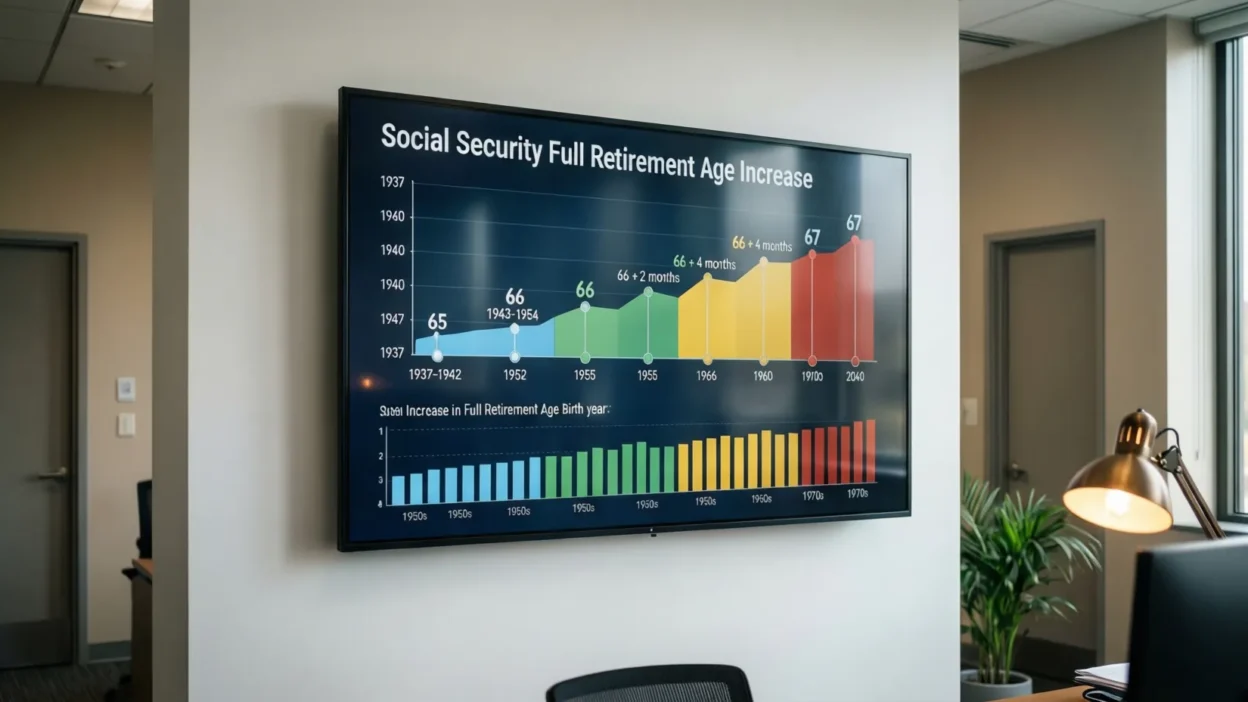
Under this phased approach, the full retirement age began rising for people born in 1938, increasing by two months per birth year. For those born between 1943 and 1954, the FRA remained at 66. It then resumed increasing for individuals born in 1955 through 1959, ultimately reaching age 67 for anyone born in 1960 or later.
Although this change is often described as a retirement age increase, it is more accurately viewed as a benefit reduction for early claimers. Workers can still claim Social Security as early as age 62, but the gap between early eligibility and full benefits has widened. Understanding this historical shift is important, because it explains why today’s retirees face different claiming decisions than previous generations—and why future changes remain a real possibility.
Current Full Retirement Age Rules (Today)
Under current Social Security rules, your full retirement age depends on your year of birth, and for many Americans, it is higher than they might expect. While age 65 was once the standard, the full retirement age has now reached 67 for anyone born in 1960 or later. This age determines when you can receive your full, unreduced retirement benefit.
For individuals born between 1943 and 1954, the full retirement age is 66. To those born from 1955 through 1959, the FRA increases gradually by two months per year. For example, someone born in 1957 has a full retirement age of 66 and six months. This phased structure reflects the long-term transition created by the 1983 reforms.
Claiming benefits before or after full retirement age has a lasting impact on monthly payments. If you claim at age 62, your benefit may be reduced by as much as 30% compared to what you would receive at FRA, depending on your birth year. These reductions are permanent and continue for life. Conversely, if you delay claiming beyond your full retirement age, you earn delayed retirement credits of roughly 8% per year, up to age 70. This can result in a benefit that is about 24% to 32% higher than your FRA amount.
It is also important to note that once you reach full retirement age, the earnings test no longer applies. This means you can work and earn any amount without reducing your Social Security benefits. Understanding today’s full retirement age rules helps clarify how timing decisions affect your long-term retirement income and why the full retirement age remains such a critical planning factor.
Why Is Full Retirement Age Increasing?
The increase in Social Security’s full retirement age is driven primarily by long-term financial and demographic pressures on the system. Social Security is funded through payroll taxes collected from current workers, and those funds are used to pay benefits to today’s retirees. As the population ages, this balance has become more difficult to maintain.
One of the biggest factors is increased life expectancy. Americans are living longer than when Social Security was first established, which means benefits are being paid out for many more years. While longer lifespans are a positive development, they significantly raise the program’s total cost. Raising the full retirement age effectively reduces lifetime benefits without cutting the base formula, helping offset these increased expenses.
Another key issue is the declining worker-to-beneficiary ratio. In the past, many more workers supported each retiree. Today, lower birth rates and the retirement of the baby boomer generation have reduced that ratio, putting additional strain on Social Security’s finances. According to projections, the trust funds could face shortfalls in the coming decades if no changes are made.
From a policy perspective, increasing the full retirement age is often viewed as a politically easier solution than raising taxes or cutting benefits outright. Because the change is typically phased in over many years, it affects future retirees more than current ones and attracts less immediate public opposition.
Together, these factors explain why policymakers continue to consider full retirement age increases as part of broader Social Security reform efforts—and why future changes remain a realistic possibility for younger workers.
Is Another Full Retirement Age Increase Coming?
The possibility of another increase in Social Security’s full retirement age is a frequent topic in policy discussions, especially as concerns about the program’s long-term solvency continue. While no new increase has been enacted, lawmakers and policy analysts regularly propose raising the FRA beyond 67 as one option to reduce future funding gaps.
Several proposals suggest gradually increasing the full retirement age to 68 or even 69, often by adding a few months per year for younger workers. These proposals typically include long phase-in periods so that people nearing retirement are not affected. If implemented, such changes would primarily impact Millennials and Gen Z, rather than current retirees or those close to claiming benefits.
If another increase will happen depends on political, economic, and public factors. Raising the full retirement age can be framed as a way to reflect longer life expectancy, but it is also controversial because it disproportionately affects workers in physically demanding jobs and those with shorter average lifespans. For this reason, proposals often face strong opposition from advocacy groups and labor organizations.
Historically, Social Security changes tend to occur only during periods of bipartisan agreement and fiscal urgency. As the trust fund depletion date approaches, pressure may increase for lawmakers to act. However, any increase to the full retirement age would almost certainly come with advance notice and a gradual rollout, giving future retirees time to adjust their plans.
While no change is guaranteed, the continued discussion alone makes it important for younger workers to plan under the assumption that today’s full retirement age rules may not remain permanent.
Next and 250 word count
VII. How a Higher Full Retirement Age Affects Your Benefits
An increase in Social Security’s full retirement age has a direct and lasting effect on the amount of benefits you receive over your lifetime. While it does not change the earliest age at which you can claim benefits—still age 62—it widens the gap between early claiming and full benefits, resulting in larger permanent reductions for those who claim early.
When the full retirement age rises, claiming at age 62 becomes more costly. For example, when the FRA was 65, early claimers faced smaller percentage reductions than they do today. With a full retirement age of 67, claiming at 62 can reduce monthly benefits by up to 30%, and if the FRA were raised further, those reductions would grow even larger. This means retirees may receive significantly less income each month for the rest of their lives.
A higher FRA also affects individuals who plan to work longer. While delayed retirement credits still reward those who wait beyond FRA, not everyone is physically or financially able to delay claiming. Workers forced to retire early due to health issues, layoffs, or caregiving responsibilities are often hit hardest by an increased retirement age.
Beyond monthly payments, a higher full retirement age can influence lifetime benefit outcomes. People who live longer may eventually recoup reduced benefits, while those with shorter life expectancies may receive less overall. This makes claiming decisions more complex and personal.
Ultimately, increases in the full retirement age shift more responsibility onto individuals to carefully plan when to claim Social Security. Understanding how these changes affect benefit calculations is essential for protecting long-term retirement income and avoiding costly claiming mistakes.
Who Is Hurt Most by Full Retirement Age Increases?
Increases to Social Security’s full retirement age do not affect all workers equally. While higher-income individuals and those in flexible careers may be able to adapt, certain groups face disproportionate challenges when the FRA rises.
Workers in physically demanding jobs—such as construction, manufacturing, healthcare support, and service industries—are among the most impacted. These individuals often cannot continue working into their late 60s due to physical strain or injury. When forced to claim benefits early, they face permanent reductions that significantly lower their lifetime income.
Lower-income workers are also hit harder by full retirement age increases. They tend to rely more heavily on Social Security as a primary source of retirement income and are less likely to have substantial savings, pensions, or investment accounts to offset reduced benefits. For these individuals, even modest reductions can create financial insecurity.
Health disparities further compound the issue. People with chronic health conditions or shorter life expectancies may not live long enough to benefit from delaying Social Security, making a higher FRA effectively a benefit cut they cannot avoid. Studies have also shown that life expectancy varies by income level, meaning the financial burden of an increased retirement age is not evenly distributed.
Caregivers—many of whom are women—may also be disproportionately affected. Time spent out of the workforce caring for children or aging relatives can reduce lifetime earnings and Social Security benefits, leaving less flexibility to delay claiming.
Together, these factors highlight why full retirement age increases are often criticized as inequitable, even though they improve the program’s finances.
Who Benefits—or Is Less Harmed—by a Higher Full Retirement Age?
While increases to the full retirement age create challenges for many workers, some groups are better positioned to absorb—or even benefit from—these changes. Generally, individuals with higher incomes, flexible careers, and strong retirement savings face fewer negative consequences from a rising FRA.
White-collar professionals and higher-income earners are often able to work longer by choice, not necessity. Jobs that are less physically demanding make it easier to remain employed into the late 60s or beyond, allowing these workers to delay claiming Social Security and avoid early retirement reductions. In many cases, they can take advantage of delayed retirement credits, which increase benefits up to age 70.
Workers with substantial retirement savings or pensions are also less affected by a higher full retirement age. Because Social Security represents a smaller portion of their overall retirement income, they can use personal savings to bridge the gap between retirement and claiming benefits. This flexibility allows them to time Social Security claims strategically rather than out of financial necessity.
People in good health with longer life expectancies may also benefit more from delaying benefits. Since they are more likely to collect Social Security for many years, higher monthly payments from delayed claiming can result in greater lifetime benefits.
Additionally, households with access to spousal benefits or dual incomes may have more claiming options, allowing one spouse to delay benefits while the other claims earlier. This coordination can help offset the impact of a higher FRA.
Although these groups may still feel the effects of a rising retirement age, their greater flexibility and resources make the adjustment far less burdensome than it is for more vulnerable workers.
Full Retirement Age vs. Early Retirement: Understanding Your Options
When it comes to claiming Social Security, the choice between early retirement and waiting until full retirement age is one of the most important decisions retirees face. While age 62 remains the earliest point at which you can claim benefits, doing so comes with permanent reductions that can significantly affect long-term income.
Claiming Social Security before reaching full retirement age results in a reduced monthly benefit because the system assumes you will collect payments for a longer period. Depending on your birth year, claiming at 62 can reduce benefits by 25% to 30% compared to your full retirement age amount. These reductions apply for life and can also reduce spousal and survivor benefits tied to your record.
Waiting until full retirement age allows you to receive 100% of your earned benefit and eliminates the earnings test, meaning you can work and earn any amount without having benefits temporarily withheld. This can be an important advantage for individuals who plan to continue working or transition into part-time employment.
Delaying beyond full retirement age offers another option. For each year you delay claiming up to age 70, your benefit increases through delayed retirement credits, typically adding about 8% per year. This strategy can substantially boost monthly income, especially for individuals who expect to live longer or who want to maximize survivor benefits for a spouse.
Ultimately, the right choice depends on factors such as health, employment, savings, and personal circumstances. Understanding the trade-offs between early retirement and full retirement age is essential for making a confident and informed Social Security claiming decision.
Strategies to Adapt to a Higher Full Retirement Age
As the full retirement age rises, proactive planning becomes increasingly important. While individuals cannot control policy changes, they can adjust their strategies to reduce the financial impact of claiming Social Security later or receiving reduced benefits.
One common approach is working longer, either full-time or part-time. Even a few additional years of earnings can increase your Social Security benefit by replacing lower-earning years in your work history. Continued employment may also provide access to employer-sponsored health insurance, helping bridge the gap until Medicare eligibility at age 65.
Coordinating Social Security with personal retirement savings is another key strategy. Drawing from 401(k)s, IRAs, or other investments before claiming Social Security can allow you to delay benefits and earn higher monthly payments later. This approach requires careful tax planning to avoid unnecessary withdrawals or higher tax brackets.
Married couples can benefit from spousal and survivor benefit strategies. For example, one spouse may claim earlier while the higher earner delays benefits to maximize the household’s long-term income and survivor protection. These coordinated strategies become more valuable as the full retirement age increases.
Healthcare planning is also critical. Because Medicare eligibility does not align with full retirement age, retirees who stop working early may need to secure alternative health coverage. Understanding COBRA, marketplace plans, or employer retiree benefits can prevent costly coverage gaps.
Finally, flexibility is essential. Building a retirement plan that accounts for multiple claiming scenarios and potential policy changes can help ensure financial stability—even in an environment of rising full retirement ages.
Common Myths About Full Retirement Age Increases
There are many misconceptions surrounding Social Security and full retirement age increases, and these myths often lead to poor retirement decisions. One common belief is that Social Security is “going bankrupt.” In reality, Social Security continues to collect payroll taxes and will be able to pay benefits even if trust fund reserves are depleted, though future payments could be reduced without reforms.
Another widespread myth is that raising the full retirement age does not reduce benefits. While the formula itself may remain unchanged, a higher FRA effectively lowers lifetime benefits for many people by increasing the penalty for early claiming. This makes the change functionally similar to a benefit cut, particularly for those who cannot delay retirement.
Some people also believe that everyone should delay claiming Social Security until age 70. While delaying can increase monthly benefits, it is not always the best option. Health, financial needs, employment status, and life expectancy all play a role. For some individuals, claiming earlier may be the more practical choice despite the reduction.
There is also confusion about the relationship between full retirement age and working. Many assume that working after claiming benefits permanently reduces Social Security payments. In fact, the earnings test only applies before reaching FRA, and any temporarily withheld benefits are later credited back.
Understanding these myths—and separating fact from fiction—is essential as full retirement age increases continue to shape retirement planning. Accurate information empowers individuals to make decisions based on their personal circumstances rather than misconceptions.
How to Estimate Your Benefits Under Current and Future Rules
Estimating your Social Security benefits is an essential step in understanding how changes to the full retirement age may affect your retirement income. The most reliable starting point is your Social Security statement, which provides benefit estimates at age 62, full retirement age, and age 70 based on your earnings history.
The Social Security Administration also offers online retirement benefit calculators that allow you to model different claiming ages and earnings scenarios. These tools help illustrate how early claiming reduces benefits and how delayed retirement credits can increase monthly payments. Reviewing multiple scenarios can provide valuable insight into how timing decisions affect long-term income.
Because future policy changes are possible, it is wise to stress-test your retirement plan. This means evaluating how your finances would hold up if full retirement age increases or if benefits are reduced. Building conservative assumptions—such as planning for a higher FRA or lower replacement rate—can make your plan more resilient.
Tax considerations should also be factored into benefit estimates. Social Security benefits may be partially taxable depending on your total income, and the timing of withdrawals from retirement accounts can affect how much of your benefit is taxed. Coordinating Social Security with other income sources can help improve net retirement income.
For more personalized projections, many individuals turn to financial planners or retirement planning software. These tools can incorporate life expectancy, spousal benefits, healthcare costs, and potential policy changes. Taking the time to estimate benefits accurately allows you to make informed decisions and adapt confidently to an evolving Social Security landscape.
What Younger Workers Should Know Now
For younger workers, Social Security retirement may seem far away, but decisions made today can significantly influence future outcomes—especially as the full retirement age continues to rise. Millennials and Gen Z are the most likely to be affected by future changes, making early awareness and planning essential.
One key takeaway is that full retirement age may be higher by the time younger workers retire. While current law sets the FRA at 67 for those born in 1960 or later, future reforms could push it even higher. Planning with the assumption that Social Security will replace a smaller portion of income can help avoid unpleasant surprises.
Younger workers should also focus on building supplemental retirement savings. Contributing consistently to employer-sponsored plans such as 401(k)s, as well as IRAs, reduces reliance on Social Security and provides greater flexibility in retirement timing. The earlier saving begins, the more time compound growth has to work.
Career flexibility is another important factor. Developing skills that allow for less physically demanding or more flexible work later in life can make it easier to delay retirement if needed. This adaptability may become increasingly valuable as full retirement age increases.
Finally, younger workers should regularly review their Social Security statements and stay informed about policy discussions. While the system is unlikely to disappear, its structure may change. Proactive planning, diversification of retirement income, and realistic expectations are the best tools younger generations have to navigate an uncertain Social Security future.
Policy Alternatives to Raising the Full Retirement Age
Raising the full retirement age is only one of several options policymakers consider to strengthen Social Security’s long-term finances. Many experts argue that alternative approaches could address funding shortfalls without disproportionately affecting vulnerable workers.
One commonly discussed option is increasing payroll taxes, either by raising the tax rate or adjusting how wages are taxed. Currently, earnings above a certain threshold are not subject to Social Security payroll taxes. Lifting or eliminating this taxable wage cap would require higher-income earners to contribute more, significantly boosting program revenue.
Another proposal involves modifying benefit formulas for higher-income retirees. Means testing or progressive benefit adjustments would preserve benefits for lower-income workers while reducing payments to those who rely less on Social Security. Supporters argue this approach improves fairness, though critics warn it could undermine public support for the program.
Policymakers also consider gradual benefit adjustments, such as changing cost-of-living calculations or adjusting delayed retirement credits. These changes can reduce long-term costs incrementally without dramatic shifts to retirement age rules.
Some proposals combine multiple strategies, spreading the burden across workers, retirees, and employers. This blended approach is often seen as more politically viable and less disruptive than relying on a single reform.
While raising the full retirement age remains a prominent option, it is far from the only solution. Understanding these alternatives helps put the retirement age debate in context and highlights that future Social Security reforms will likely involve trade-offs between solvency, fairness, and retirement security.
Expert Opinions and Public Debate
The debate over increasing Social Security’s full retirement age reflects a broader tension between financial sustainability and social equity. Economists, policymakers, and advocacy groups often agree that action is needed to address long-term funding challenges, but they differ sharply on how those changes should be implemented.
Supporters of raising the full retirement age argue that it aligns Social Security with longer life expectancy and modern work patterns. They contend that gradual increases, phased in over decades, give workers time to adapt while reducing strain on the system. From this perspective, raising the FRA is seen as a pragmatic way to preserve benefits for future generations without sharp tax increases.
Opponents, however, emphasize the unequal impact of retirement age increases. Labor groups and social advocates argue that many workers—particularly those in physically demanding jobs or with health limitations—cannot realistically work longer. They point to disparities in life expectancy by income and occupation, suggesting that a higher FRA effectively cuts benefits for those who need them most.
Public opinion often reflects this divide. While many Americans express concern about Social Security’s future, there is also strong resistance to changes perceived as benefit cuts. As a result, proposals to raise the full retirement age tend to be politically sensitive and controversial.
Most experts agree on one point: any reform will involve trade-offs. The challenge lies in balancing fiscal responsibility with the program’s core mission of providing reliable retirement income. This ongoing debate will shape how Social Security evolves—and who bears the cost of ensuring its long-term viability.
Key Takeaways and Action Steps
The increase in Social Security’s full retirement age has reshaped how Americans plan for retirement, and its effects will continue to grow in the years ahead. While the full retirement age is now 67 for many workers, the broader trend highlights the importance of understanding how policy changes directly affect lifetime benefits.
One key takeaway is that a higher full retirement age effectively reduces benefits for those who claim early. Even though early eligibility remains at age 62, the permanent reduction in monthly payments can significantly impact long-term retirement income. For this reason, timing your Social Security claim is more important than ever.
Another important lesson is that planning flexibility matters. Workers who can stay employed longer, coordinate Social Security with personal savings, or use spousal strategies are better positioned to adapt to rising retirement ages. Conversely, those with health challenges or physically demanding jobs may need to plan earlier and more conservatively.
Action steps vary by age group. Near-retirees should review their Social Security statements, estimate benefits at different claiming ages, and evaluate healthcare and income needs. Younger workers should focus on building supplemental savings and developing career flexibility, while assuming that future rules may be less generous.
Finally, staying informed is essential. Social Security reforms tend to happen gradually, but their impact is lasting. By understanding the full retirement age increase and planning proactively, individuals can make confident decisions and protect their financial security in an evolving retirement landscape.
Frequently Asked Questions (FAQ)
Can my full retirement age be different from someone else’s?
Yes. Your full retirement age is determined by your year of birth. While many people now have an FRA of 67, those born earlier may have a full retirement age of 66 or somewhere in between.
Does full retirement age affect spousal benefits?
Yes. Claiming spousal benefits before your own full retirement age can result in reduced payments. Waiting until FRA allows you to receive the maximum spousal benefit available to you.
What happens if I keep working after reaching full retirement age?
Once you reach full retirement age, you can work and earn any amount without reducing your Social Security benefits. In some cases, continued work can even increase your benefit if higher earnings replace lower-earning years in your record.
Can Congress change the full retirement age again?
Yes. Congress has the authority to change Social Security rules, including the full retirement age. However, any increase would almost certainly be phased in gradually and apply mainly to younger workers.
Does full retirement age affect disability benefits?
Full retirement age does not change eligibility for Social Security Disability Insurance (SSDI). However, when a person receiving disability benefits reaches full retirement age, those benefits automatically convert to retirement benefits.
Is it better to wait until full retirement age to claim Social Security?
There is no universal answer. The best claiming age depends on health, finances, employment status, and life expectancy. For some, waiting makes sense; for others, claiming earlier may be necessary.
These common questions highlight why understanding full retirement age is so important. Clear knowledge helps you make informed decisions and avoid costly misunderstandings as retirement approaches.
Conclusion:
The gradual increase in Social Security’s full retirement age reflects broader demographic and financial shifts that are reshaping retirement in the United States.
While these changes are often discussed in abstract policy terms, their real-world impact is deeply personal, affecting when people retire, how much income they receive, and how secure they feel in their later years.
As the full retirement age rises, Social Security claiming decisions become more complex and more consequential.
Claiming too early can permanently reduce benefits, while delaying may not be realistic for everyone.
This makes informed planning essential. Understanding your full retirement age, evaluating multiple claiming scenarios, and coordinating Social Security with other income sources can help mitigate the effects of these changes.
The good news is that individuals are not powerless. By staying informed, building supplemental savings, and maintaining flexibility in work and retirement plans, it is possible to adapt to a higher full retirement age.
For younger workers in particular, early and consistent planning can offset future reductions and create greater financial independence.
Ultimately, Social Security remains a vital foundation of retirement income, even as its rules evolve.
Planning ahead—rather than reacting at the last minute—allows you to make thoughtful choices, protect your financial well-being, and navigate retirement with greater confidence in an era of increasing retirement ages.

Jonathan Bishopson is the punmaster-in-chief at ThinkPun.com, where wordplay meets wit and every phrase gets a clever twist. Known for turning ordinary language into laugh-out-loud lines, Jonathan crafts puns that make readers groan, grin, and think twice. When he’s not busy bending words, he’s probably plotting his next “pun-derful” masterpiece or proving that humor really is the best re-word.