
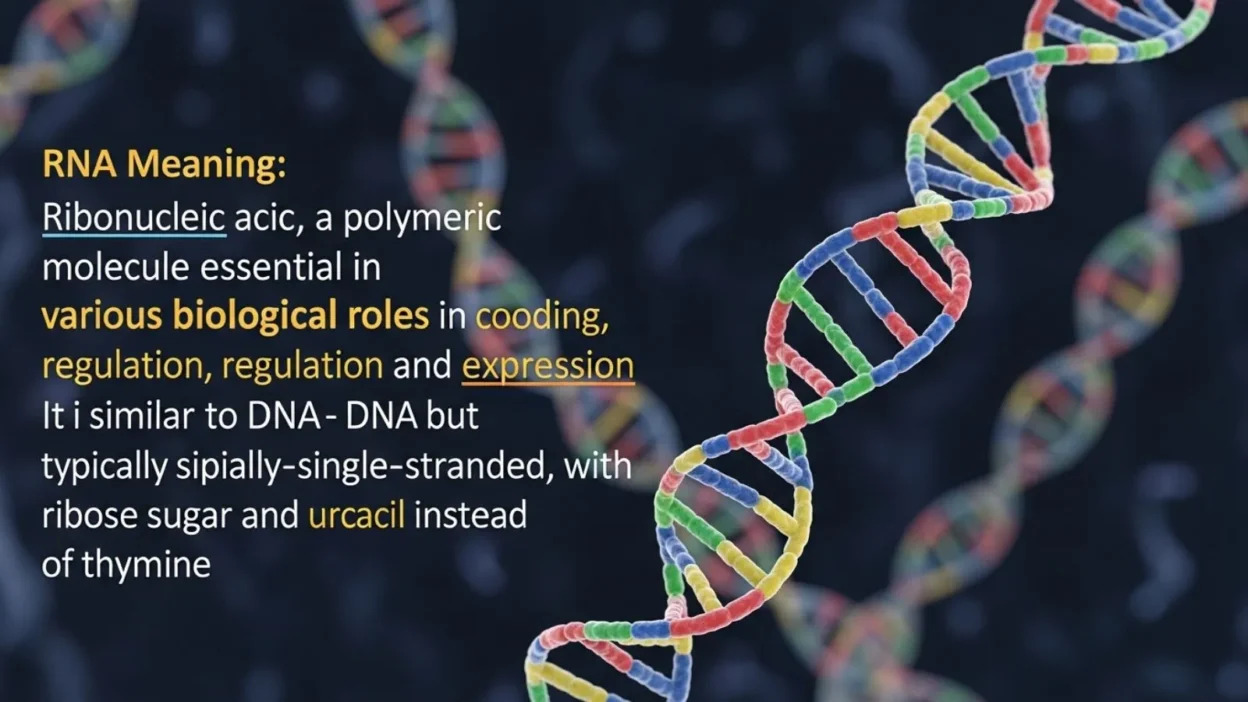
RNA, or Ribonucleic Acid, is one of the most essential molecules in every living cell, yet many people are unsure about its true meaning and role.
While DNA often steals the spotlight as the carrier of genetic information, RNA is the dynamic molecule that actually helps bring genetic instructions to life.
From guiding protein production to regulating gene expression, RNA performs functions that are vital for growth, repair, and overall cellular health. Its importance has become even more visible in recent years with the rise of mRNA vaccines, which harness RNA to protect millions from diseases like COVID-19.
Understanding the meaning of RNA goes beyond biology textbooks it connects to medicine, biotechnology, and even cutting-edge genetic research. In this article, we’ll explore everything you need to know about RNA: its types, structure, functions, and why it is a cornerstone of life itself.
History and Discovery of RNA
The journey to understanding RNA began over a century ago, long before its critical role in cells was fully appreciated. In the late 1800s, scientists like Friedrich Miescher, who first discovered nucleic acids, laid the groundwork by identifying molecules containing phosphorus in the cell nucleus. However, at the time, DNA was the main focus, and RNA remained largely a mystery.
The term ribonucleic acid (RNA) was first introduced in the early 20th century as researchers identified a separate class of nucleic acids distinct from DNA. In the 1940s and 1950s, breakthroughs in biochemistry allowed scientists to isolate RNA and observe its functions. One of the most significant discoveries came with the identification of messenger RNA (mRNA), which carries genetic instructions from DNA to ribosomes for protein synthesis. This clarified RNA’s central role in expressing the information stored in genes.
Further research revealed other types of RNA, such as transfer RNA (tRNA) and ribosomal RNA (rRNA), highlighting RNA’s diverse roles in the cell. In 1955, Severo Ochoa and his team made a landmark contribution by discovering RNA enzymes capable of catalyzing reactions, emphasizing that RNA was not just a messenger but also a functional molecule.
Today, RNA research has expanded into medicine and biotechnology, with innovations like mRNA vaccines and RNA-based therapies revolutionizing healthcare. Understanding its history gives us a deeper appreciation for how RNA evolved from a little-known molecule to a cornerstone of modern biology.
Structure of RNA
RNA, or Ribonucleic Acid, is a molecule built from a chain of smaller units called nucleotides, which are its structural building blocks. Each nucleotide is composed of three components: a phosphate group, a ribose sugar, and one of four nitrogenous bases — Adenine (A), Uracil (U), Cytosine (C), or Guanine (G). Unlike DNA, RNA contains uracil instead of thymine, which is a key distinction between these two nucleic acids.
Another important feature of RNA is that it is usually single-stranded, whereas DNA is double-stranded. This single-stranded structure allows RNA to fold into complex shapes, forming loops, hairpins, and other three-dimensional structures that are crucial for its function. These shapes are especially important for tRNA and rRNA, which need precise folding to perform protein synthesis and catalytic roles in the ribosome.
RNA is also less chemically stable than DNA due to the hydroxyl group (-OH) on the ribose sugar, making it more reactive and short-lived inside cells. This instability is actually advantageous, allowing cells to rapidly produce and degrade RNA as needed, which helps regulate protein production and respond quickly to changing cellular conditions.
Understanding the structure of RNA is essential because its shape directly influences its function. From carrying genetic instructions as mRNA to catalyzing reactions as ribozymes, the unique structure of RNA makes it a versatile and indispensable molecule in all forms of life.
Types of RNA
RNA is not a single, uniform molecule; it exists in several types, each with a specialized role in the cell. Understanding the different types of RNA is key to grasping its meaning and importance in biology.
1. Messenger RNA (mRNA):
This type carries genetic instructions from DNA in the nucleus to the ribosomes, where proteins are synthesized. Think of mRNA as a “blueprint” that tells the cell how to assemble amino acids into functional proteins.
2. Transfer RNA (tRNA):
tRNA acts as the “translator” in protein synthesis. It reads the sequence of mRNA and brings the correct amino acids to the ribosome, ensuring proteins are built accurately. Each tRNA molecule recognizes specific codons on the mRNA strand.
3. Ribosomal RNA (rRNA):
rRNA is a major component of ribosomes, the cellular machines responsible for protein production. It not only provides structural support but also catalyzes the formation of peptide bonds between amino acids, making it essential for protein synthesis.
4. Non-coding RNA:
Not all RNA codes for proteins. Non-coding RNAs, such as microRNA (miRNA) and small interfering RNA (siRNA), play critical roles in regulating gene expression and protecting cells from viral infections. Long non-coding RNAs (lncRNA) are also involved in controlling complex cellular processes.
Functions of RNA (250 words)
RNA plays a central role in the life of a cell, performing multiple functions that are essential for growth, survival, and adaptation. One of its primary roles is protein synthesis. Messenger RNA (mRNA) carries genetic instructions from DNA to ribosomes, where transfer RNA (tRNA) helps assemble amino acids into proteins. Ribosomal RNA (rRNA) then catalyzes the formation of peptide bonds, completing the process. Without RNA, cells would be unable to produce the proteins necessary for virtually all biological activities.
Beyond protein synthesis, RNA is vital in gene regulation. Non-coding RNAs such as microRNA (miRNA) and small interfering RNA (siRNA) control which genes are expressed and at what level. This regulatory function ensures cells respond correctly to internal signals and environmental changes.
RNA can also act as a catalyst. Certain RNA molecules, called ribozymes, can speed up chemical reactions within the cell, proving that RNA is not just a messenger but an active participant in cellular processes.
In addition, RNA serves as genetic material for many viruses, including influenza, HIV, and coronaviruses. This allows these viruses to replicate and infect host cells efficiently.
Finally, RNA is crucial in modern medicine and biotechnology, from mRNA vaccines that protect against diseases to RNA-based therapies targeting specific genetic conditions. By coordinating protein production, regulating genes, catalyzing reactions, and serving as viral genetic material, RNA proves itself to be one of the most versatile and indispensable molecules in life.
RNA vs DNA
While RNA and DNA are both nucleic acids essential to life, they differ in structure, function, and stability. DNA, or deoxyribonucleic acid, is the long-term storage of genetic information, typically double-stranded and found primarily in the cell nucleus. RNA, in contrast, is usually single-stranded, more flexible, and acts as a temporary messenger and functional molecule within the cell.
Structurally, RNA contains the sugar ribose, whereas DNA contains deoxyribose, which lacks one oxygen atom. This small difference makes RNA more reactive and less chemically stable than DNA, which is why RNA is often short-lived, designed to carry out its functions and then degrade. Another distinction is in their nitrogenous bases: RNA uses uracil (U) instead of thymine (T), which pairs with adenine in DNA.
Functionally, DNA serves as the blueprint of life, storing the instructions for building and maintaining an organism. RNA, on the other hand, translates these instructions into action. mRNA carries coding information from DNA to ribosomes, tRNA assembles amino acids into proteins, and rRNA catalyzes peptide bond formation. Additionally, non-coding RNAs regulate gene expression and cellular processes.
Finally, DNA is generally more stable, suitable for long-term storage, while RNA’s versatility allows it to perform multiple roles, from protein synthesis to catalysis and regulation. Understanding these differences is crucial for appreciating how genetic information is stored, expressed, and controlled in living organisms.
RNA in Biotechnology & Medicine
RNA has become a cornerstone of modern biotechnology and medicine, with its roles extending far beyond traditional biology. One of the most prominent applications is mRNA vaccines, which gained global attention during the COVID-19 pandemic. These vaccines use synthetic mRNA to instruct cells to produce a harmless piece of a virus’s protein, triggering an immune response without causing disease. This approach has revolutionized vaccine development, offering rapid, flexible, and effective solutions against emerging pathogens.
Beyond vaccines, RNA plays a critical role in gene therapy. Scientists are exploring RNA-based treatments that can correct genetic defects by delivering functional RNA molecules into cells. For example, small interfering RNA (siRNA) can silence harmful genes, offering potential cures for diseases like certain cancers, rare genetic disorders, and viral infections.
RNA also underpins many diagnostic technologies. Techniques like reverse transcription PCR (RT-PCR) detect viral RNA in patient samples, providing rapid and accurate disease diagnosis. In addition, RNA-based drugs are being developed to target previously “undruggable” pathways, making RNA a versatile therapeutic tool.
In biotechnology research, RNA is used in CRISPR-Cas systems, where guide RNAs direct molecular “scissors” to specific DNA sequences, enabling precise gene editing. This has vast implications for agriculture, medicine, and synthetic biology.
Overall, RNA’s adaptability and functional diversity make it an indispensable tool in science and medicine. From vaccines and diagnostics to gene editing and therapeutics, RNA is transforming healthcare and biotechnology, illustrating its critical importance in both research and real-world applications.
RNA in Evolution and Research
RNA is not only central to modern biology but also offers critical insights into the origins of life. The RNA World Hypothesis proposes that early life forms relied primarily on RNA for both genetic information storage and catalytic activity, before DNA and proteins evolved. Unlike DNA, RNA can both carry information and catalyze chemical reactions, making it a plausible candidate for the first self-replicating molecule. This theory has been supported by the discovery of ribozymes, RNA molecules that act as enzymes, proving that RNA can perform functions typically reserved for proteins.
In modern research, RNA continues to be a focus of scientific innovation. Studies on non-coding RNA reveal its crucial role in regulating genes, controlling cell differentiation, and maintaining genomic stability. For example, microRNAs (miRNAs) can silence specific genes, while long non-coding RNAs (lncRNAs) orchestrate complex regulatory networks within cells.
RNA also plays a major role in virology and infectious disease research. Many viruses, including influenza, HIV, and coronaviruses, use RNA as their genetic material. Understanding viral RNA replication and translation is essential for developing antiviral drugs, vaccines, and diagnostic tests.
Additionally, cutting-edge technologies like RNA sequencing (RNA-Seq) allow researchers to study gene expression patterns across tissues and conditions, opening new avenues in precision medicine and biotechnology.
By bridging the past and the future, RNA demonstrates both its evolutionary significance and its potential to drive next-generation scientific discoveries, proving that this versatile molecule remains central to understanding life and advancing medicine.
Common Misconceptions About RNA
Despite its central role in biology and medicine, RNA is often misunderstood. One common misconception is that RNA is simply a “messenger” molecule with no other functions. While mRNA does carry genetic instructions from DNA to ribosomes, RNA also has catalytic roles, regulatory functions, and structural responsibilities in the cell. Molecules like rRNA and tRNA are essential for protein synthesis, while ribozymes demonstrate RNA’s ability to catalyze chemical reactions independently.
Another misunderstanding is that all RNA codes for proteins. In reality, non-coding RNAs, such as microRNAs (miRNAs), small interfering RNAs (siRNAs), and long non-coding RNAs (lncRNAs), do not produce proteins but regulate gene expression, control cell development, and maintain genomic stability. Ignoring these RNAs overlooks some of the most important layers of cellular control.
Some people also assume RNA is only important in viruses. While many viruses use RNA as their genetic material, RNA is fundamental in all living cells, from bacteria to humans. Its role in transcription, translation, and regulation makes it indispensable for life itself.
Finally, RNA is sometimes thought to be unstable and therefore unimportant. In fact, its short-lived nature is an advantage, allowing cells to quickly adjust protein production and respond to environmental changes.
Understanding these misconceptions is crucial for appreciating RNA’s true significance. Far from being just a passive messenger, RNA is a versatile, multifunctional molecule that orchestrates life at the cellular and molecular level.
Future of RNA Science
The future of RNA science is incredibly promising, with research and innovation expanding rapidly across medicine, biotechnology, and genetics. One of the most exciting areas is RNA-based therapeutics, which aim to treat diseases by directly targeting RNA molecules. Technologies such as small interfering RNA (siRNA) and antisense oligonucleotides (ASOs) are already being used to silence harmful genes or correct genetic disorders, offering new hope for conditions once considered untreatable.
mRNA technology is also set to transform vaccines and personalized medicine. Beyond COVID-19, researchers are developing mRNA vaccines for influenza, cancer, and even autoimmune diseases. The flexibility of mRNA allows scientists to quickly design vaccines for emerging pathogens, making it a powerful tool in global health preparedness.
In addition, RNA editing and synthetic RNA molecules are opening new possibilities in biotechnology. CRISPR-Cas systems targeting RNA allow precise modification of gene expression without altering the DNA, reducing potential risks and expanding the toolkit for genetic engineering.
RNA research also contributes to precision medicine, where patient-specific RNA profiles guide treatment plans. RNA sequencing (RNA-Seq) and computational modeling provide insights into gene expression, disease mechanisms, and drug response, enabling highly personalized healthcare.
As science progresses, RNA’s versatility and adaptability promise to redefine medicine, agriculture, and synthetic biology. From advanced therapies and vaccines to gene regulation and diagnostic innovations, RNA continues to be at the forefront of scientific discovery, demonstrating that its potential is far from fully realized.
Frequently Asked Questions (FAQ) About RNA
1. What does RNA mean?
RNA stands for Ribonucleic Acid, a molecule essential for carrying genetic information and performing various cellular functions. It helps express DNA instructions and plays roles in protein synthesis, gene regulation, and catalysis.
2. How is RNA different from DNA?
RNA is usually single-stranded, contains the sugar ribose, and uses uracil (U) instead of thymine (T). DNA is double-stranded, contains deoxyribose, and stores long-term genetic information, whereas RNA acts as a messenger and functional molecule.
3. What are the main types of RNA?
The major types are:
- mRNA (Messenger RNA): Carries genetic instructions for protein synthesis.
- tRNA (Transfer RNA): Translates mRNA into amino acids.
- rRNA (Ribosomal RNA): Forms the core of ribosomes and catalyzes protein assembly.
- Non-coding RNA: Includes miRNA, siRNA, and lncRNA, which regulate gene expression.
4. Why is RNA important in medicine?
RNA enables mRNA vaccines, gene therapy, and RNA-based drugs. It is used to detect diseases through diagnostic tests like PCR and can be targeted to treat genetic disorders.
5. Can RNA act as an enzyme?
Yes! Certain RNA molecules, called ribozymes, can catalyze chemical reactions, demonstrating RNA’s versatility beyond just carrying genetic information.
6. Is RNA only found in viruses?
No, RNA is present in all living cells and is vital for life. Viruses use RNA as genetic material, but cellular RNA is fundamental for protein production, regulation, and catalysis.
Conclusion:
RNA, or Ribonucleic Acid, is far more than just a messenger between DNA and proteins it is a versatile and indispensable molecule that drives essential processes in every living cell.
From protein synthesis and gene regulation to acting as a catalyst in biochemical reactions, RNA plays multiple roles that are critical for life. Its unique structure, types, and functions make it central to understanding biology, evolution, and medicine.
In recent years, RNA has moved to the forefront of scientific innovation. mRNA vaccines, RNA-based therapies, and gene-editing technologies highlight its transformative potential in healthcare and biotechnology.
As research continues, RNA is likely to unlock new possibilities in disease treatment, personalized medicine, and genetic engineering.
Understanding the meaning of RNA helps us appreciate its significance not just in textbooks but in everyday scientific breakthroughs.
This remarkable molecule remains a cornerstone of life and a key player in shaping the future of medicine and biotechnology.