
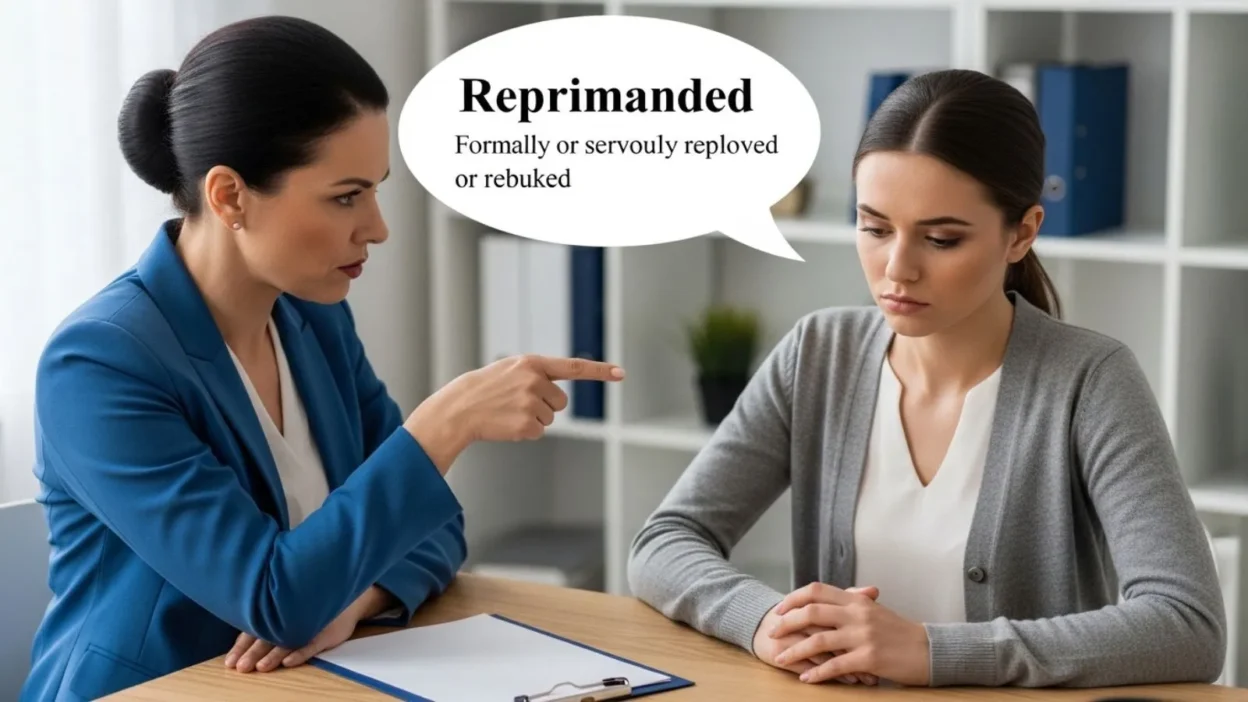
Being reprimanded is something almost everyone experiences at some point—whether at school, in the workplace, or even at home. But what does it really mean to be reprimanded?
Understanding the reprimanded meaning is important not just for expanding your vocabulary, but also for navigating professional and personal situations with confidence.
In simple terms, to be reprimanded means to receive a formal or serious expression of disapproval for a mistake or misbehavior.
Unlike casual scolding, reprimands are usually official and carry a sense of authority. In this article, we’ll explore the definition of reprimanded, provide practical
examples,
And highlight the subtle differences between similar words like “rebuked,” “admonished,” and “scolded.”
If you’re learning English, improving your communication skills, or just curious about workplace etiquette, this guide will help you fully grasp the concept of being reprimanded and how to respond to it professionally and effectively.
What Does “Reprimanded” Mean?
The term “reprimanded” is the past tense of the verb “reprimand” and is commonly used to describe a situation where someone is formally or seriously told that their behavior or actions were unacceptable. When a person is reprimanded, it usually implies a level of authority behind the correction—think of teachers, managers, or supervisors addressing mistakes or misconduct. Unlike casual scolding, being reprimanded carries a sense of official disapproval and often serves as a warning for future behavior.
For example, if an employee repeatedly misses deadlines, their manager may reprimand them during a meeting to emphasize the importance of accountability. Similarly, a student caught cheating on an exam might be reprimanded by their teacher, highlighting that the behavior is unacceptable and must not happen again. In both cases, the goal of a reprimand isn’t just to express dissatisfaction but also to correct behavior and set clear boundaries.
It’s important to note that reprimanded meaning is not always negative in the long term. While it can feel uncomfortable, a reprimand is often a learning opportunity. It helps individuals recognize mistakes, understand expectations, and improve their actions. Using the term correctly in conversation or writing also conveys a sense of formality and precision, making your communication clearer and more professional.
Origin and History of “Reprimanded”
The word “reprimanded” has a rich history that traces back to Latin. It comes from the Latin verb reprimere, which means “to press back” or “to check.” Over time, this evolved in Middle English to “reprimanden”, carrying the meaning of restraining or expressing disapproval. By the 16th century, reprimand had become a formal term in English to describe official correction or admonishment, often used in legal, military, and educational contexts.
Historically, being reprimanded was a serious matter. In schools, students could be formally reprimanded by teachers for misbehavior. In workplaces or royal courts, employees or courtiers who made mistakes could receive official reprimands as part of maintaining discipline and order. Even today, the formal tone of reprimanded carries that sense of authority and seriousness, distinguishing it from casual phrases like “scolded” or “told off.”
Interestingly, the word’s evolution reflects its purpose: to correct and guide behavior. While casual corrections are informal, reprimanded implies a structured, intentional approach to setting boundaries. This makes it especially relevant in professional, educational, and legal environments where clarity and authority are essential.
Understanding the historical background of reprimanded not only gives insight into its meaning but also explains why it remains a formal and widely respected term in English. In the next sections, we’ll look at practical examples of reprimanded in real-life situations, helping you see how the word is used today.
Examples of “Reprimanded” in Sentences
Understanding the reprimanded meaning becomes much clearer when you see it used in real-life examples. A reprimand is often formal, serious, and delivered by someone in authority, such as a manager, teacher, or supervisor. Here are some practical examples across different contexts:
Workplace:
- “The employee was reprimanded by the manager for submitting incomplete reports.”
- “After missing the client meeting, she was reprimanded and given instructions on how to avoid future mistakes.”
School or Academic Settings:
- “The student was reprimanded for arriving late to class multiple times.”
- “He was reprimanded by the principal for breaking school rules.”
Everyday or Informal Situations:
- “She reprimanded her younger brother for drawing on the walls.”
- “He was reprimanded by his coach for not attending practice regularly.”
These examples show that a reprimand is not just a casual scolding—it carries authority and a clear message that the behavior needs correction. Using reprimanded in a sentence communicates seriousness, formality, and accountability.
It’s also helpful to notice the tone in these examples: while the word indicates disapproval, it often comes with guidance or expectations for improvement. This differentiates it from words like “punished” or “shouted at,” which may not offer a chance for correction.
Synonyms and Similar Words
While reprimanded is a formal way to express disapproval, several similar words exist in English, each with its own nuance. Understanding these synonyms helps you use the word accurately in different contexts.
1. Scolded
This is more informal and often used in familial or casual situations. Parents commonly scold children for minor mistakes, like spilling milk or forgetting homework. Unlike reprimanded, scolding usually lacks official authority and is less formal.
2. Rebuked
Rebuked is closer in formality to reprimanded but often implies a stronger, sharper criticism. For example, an employee may be rebuked for serious misconduct, emphasizing the severity of the wrongdoing.
3. Admonished
Admonished is formal and slightly gentler than reprimanded. It often serves as a warning or guidance rather than a strict correction. Teachers may admonish students to encourage better behavior without harshness.
4. Chastised
Chastised suggests a more intense form of reprimand, sometimes implying embarrassment or punishment along with correction. Historical texts often use this word in formal or literary contexts.
5. Corrected
While less severe, corrected can be used when pointing out errors in a neutral or professional way, such as correcting a report or a statement.
Antonyms of “Reprimanded”
While being reprimanded involves formal disapproval, it’s equally important to understand its opposites—words that convey approval, praise, or encouragement. Knowing the antonyms of reprimanded helps you accurately express positive feedback and avoid confusion in communication.
1. Praised
This is the most direct antonym of reprimanded. When someone is praised, their actions are acknowledged positively.
For example,
“The student was praised for completing the project ahead of schedule.” Unlike a reprimand, praise motivates and reinforces desirable behavior.
2. Complimented
Complimented is slightly less formal than praised but carries a similar meaning. It often highlights specific actions or qualities.
Example:
“She was complimented on her clear presentation skills.”
3. Rewarded
Rewards go beyond verbal approval and involve tangible recognition.
For instance,
“The employee was rewarded for excellent performance with a bonus.” Rewards can accompany praise to reinforce positive behavior.
4. Encouraged
Encouragement focuses on support and motivation rather than correction.
Example:
“The teacher encouraged the student to keep improving in mathematics.” While a reprimand highlights mistakes, encouragement emphasizes potential and growth.
5. Approved
Approved can be used in formal contexts, particularly for actions, plans, or work.
For instance,
“The manager approved the team’s proposal,” showing recognition rather than criticism.
How to Handle Being Reprimanded Professionally
Being reprimanded can feel uncomfortable, especially in the workplace or a professional setting. However, how you respond can make a big difference in maintaining your reputation and learning from the situation. Here are some practical tips on handling a reprimand professionally:
1. Stay Calm and Listen Carefully
When someone reprimands you, it’s natural to feel defensive. Instead, take a deep breath and focus on listening. Understanding the concerns clearly shows maturity and respect for authority.
2. Acknowledge Mistakes Without Excuses
Admitting your error demonstrates accountability. Avoid blaming others or making excuses. A simple statement like, “I understand my mistake and will correct it,” can go a long way in showing professionalism.
3. Ask for Guidance
If the reprimand isn’t clear, politely ask how to improve. For example, “Could you please guide me on how to handle this better next time?” This shows willingness to learn and grow.
4. Take Corrective Action
Apply the feedback to prevent the same mistake. Following through reinforces that you take the reprimand seriously and are committed to improvement.
5. Reflect and Learn
After the incident, take time to reflect on what went wrong and how you can avoid it in the future. Viewing a reprimand as a learning opportunity turns a negative experience into professional growth.
Common Mistakes and Misuse of Reprimanded
While reprimanded is a widely used word, many people make mistakes in its usage, which can lead to confusion or miscommunication. Understanding these common errors will help you use the word accurately in both professional and casual settings.
1. Confusing Reprimanded with Punished
One common mistake is using reprimanded interchangeably with punished. While both indicate disapproval, punishment usually involves a consequence or penalty, whereas a reprimand is a formal verbal or written correction. For example, “He was reprimanded for missing deadlines” is different from “He was punished by being suspended.”
2. Using It in Informal Contexts Incorrectly
Some people overuse reprimanded in casual conversation, where words like “scolded” or “told off” would be more appropriate. Saying, “I reprimanded my friend for being late to coffee” sounds overly formal and out of place.
3. Ignoring the Formal Tone
Because reprimanded is formal, it is often misapplied in informal writing, like social media posts or casual messages. Maintaining proper context ensures the word retains its meaning and authority.
4. Misusing Tense or Subject
Another error is incorrect tense, such as saying, “He reprimands yesterday” instead of “He was reprimanded yesterday.” Ensure the verb form matches the time and subject.
Reprimanded in Pop Culture and Media
The term reprimanded is not only used in formal settings but also frequently appears in movies, TV shows, books, and news reports. Its presence in pop culture helps audiences understand the serious tone and authority behind the word.
In workplace dramas or sitcoms, characters are often reprimanded to highlight mistakes and drive plot development. For example, in a popular office-based TV show, a manager may reprimand an employee for missing an important deadline. These scenes not only teach viewers about professional boundaries but also make the term relatable in everyday life.
In literature, authors use reprimanded to convey authority and discipline. A principal reprimanding a student, or a military officer reprimanding a soldier, adds tension and underscores the hierarchy within the story. This formal use emphasizes accountability and the consequences of actions.
News media also frequently reports instances of public figures or employees being reprimanded. Headlines like “Politician reprimanded for inappropriate comments” or “Teacher reprimanded for classroom incident” show how the word communicates seriousness while remaining professional.
Even in informal social media commentary, the word reprimanded is sometimes used humorously to describe minor mistakes, helping the audience connect with its meaning in a lighthearted way.
By seeing reprimanded in pop culture and media, readers can better understand its tone, context, and real-world application. It demonstrates that a reprimand is not just a word but a formal tool for correction, guidance, and accountability in various aspects of life.
Key Takeaways
Understanding the term reprimanded is essential for both effective communication and professional growth. At its core, being reprimanded means receiving formal or serious disapproval for behavior or mistakes. Unlike casual scolding, a reprimand carries authority and serves as a corrective measure rather than just an expression of frustration.
Throughout this article, we’ve explored the reprimanded meaning, its origins, and how it evolved from the Latin word reprimere, meaning “to press back or restrain.” We also looked at practical examples across workplaces, schools, and everyday situations, showing how the word is applied to guide and correct behavior.
We discussed synonyms like “scolded,” “rebuked,” “admonished,” and “chastised,” each with its own nuance, as well as antonyms such as “praised,” “complimented,” and “encouraged,” which emphasize approval instead of correction. Understanding these related terms helps you choose the right word for formal or informal contexts.
Handling a reprimand professionally involves staying calm, acknowledging mistakes, asking for guidance, and taking corrective action. Avoiding common mistakes, like misusing the word in informal settings or confusing it with punishment, ensures accurate communication.
Finally, seeing reprimanded in pop culture, literature, and news highlights its formal tone and real-world applications. By grasping the meaning, context, and proper usage, you can confidently use reprimanded in both writing and speech, demonstrating clarity, professionalism, and understanding.
Frequently Asked Questions (FAQ) About “Reprimanded”
1. What does “reprimanded” mean?
“Reprimanded” is the past tense of “reprimand” and means receiving formal or serious disapproval for a mistake or unacceptable behavior. It is typically used in professional, educational, or authoritative contexts.
2. How is “reprimanded” different from “scolded”?
While both indicate disapproval, “scolded” is informal and often used with children or casual situations. “Reprimanded” is formal and usually involves authority, like a manager, teacher, or supervisor.
3. Can being reprimanded be positive?
Yes. Although it may feel uncomfortable, a reprimand can be a learning opportunity. It highlights mistakes, sets boundaries, and provides guidance for improvement. Handling it professionally can strengthen skills and reputation.
4. What are some synonyms of “reprimanded”?
Common synonyms include rebuked, admonished, chastised, and scolded. Each carries a slightly different tone and level of formality. Choosing the right synonym depends on the context.
5. What are the antonyms of “reprimanded”?
Antonyms convey approval or encouragement, such as praised, complimented, rewarded, and encouraged. They indicate positive reinforcement instead of correction.
6. How can I respond professionally when reprimanded?
Stay calm, acknowledge your mistake, ask for guidance, take corrective action, and view the feedback as a growth opportunity. This demonstrates accountability and professionalism.
Conclusion
Understanding the reprimanded meaning is essential for clear, professional, and effective communication.
A reprimand is more than just disapproval it is a formal expression of correction, often delivered by someone in authority, whether in the workplace, school, or other structured settings.
Unlike casual scolding, it carries weight and conveys seriousness, helping guide behavior and set clear expectations.
Throughout this article, we explored the definition, history, practical examples, synonyms, antonyms, and professional tips for handling reprimands.
We also examined how the term appears in pop culture and media, showing its relevance in both formal and relatable contexts.
By understanding when and how to use reprimanded correctly, you can communicate with precision, professionalism, and confidence.
Remember, being reprimanded is not just a correction it’s an opportunity to learn, improve, and grow. Apply these insights, and you’ll handle reprimands effectively in any setting.