
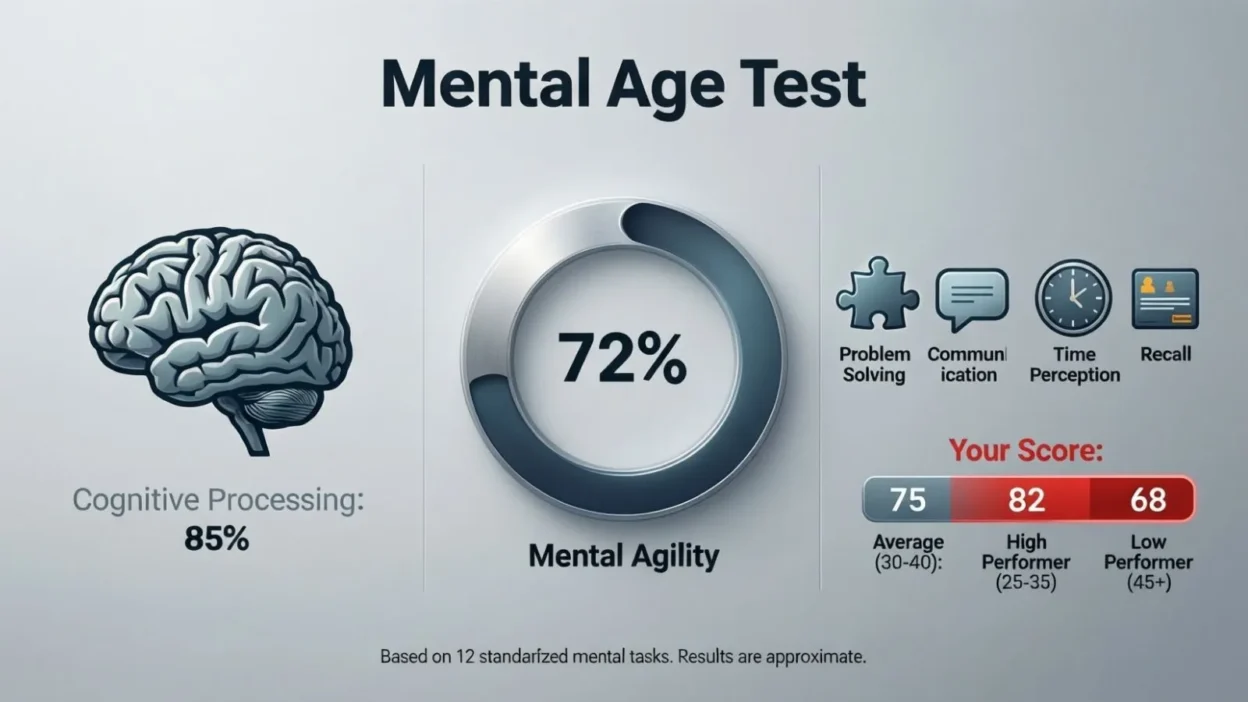
Ever wondered if your mind is younger or older than your actual age? A Mental Age Test is a fun and insightful way to discover how you think, react, and make decisions compared to different age groups.
Unlike your chronological age, mental age reflects your mindset, emotional responses, and everyday behavior. ‘
Some people may be mature beyond their years, while others keep a youthful, playful outlook on life.
Mental age tests have gained massive popularity online because they combine psychology with entertainment.
By answering a series of simple questions, you can get a clearer idea of how old your mind really is.
These tests are not about intelligence or judgment they are designed for self-reflection and curiosity.
In this guide, you’ll learn what a mental age test is, how it works, how accurate it is, and what your results may reveal about your personality. Ready to find out your real mental age? Let’s begin.
What Is a Mental Age Test?
A Mental Age Test is a psychological-style assessment designed to estimate how old your mind is based on your thoughts, behavior, and emotional responses. Instead of focusing on your physical age, this test measures your mindset—how you process information, solve problems, handle emotions, and interact with the world around you. The result is your mental age, which may be younger, older, or the same as your actual age.
The concept of mental age comes from early psychological studies that aimed to understand intellectual and emotional development. Over time, this idea evolved into modern mental age quizzes, which are now widely used for entertainment, self-awareness, and personality insights. Today’s mental age tests often combine logic-based questions, lifestyle choices, emotional reactions, and personal preferences to evaluate different mental traits.
It’s important to understand that a mental age test does not measure intelligence, academic ability, or mental health. Instead, it reflects patterns in thinking and behavior. For example, someone with a younger mental age may be more creative, spontaneous, and playful, while someone with an older mental age may show wisdom, patience, and emotional stability.
Most online mental age tests are quick and easy to take, making them popular on social media and psychology websites. While they are not clinical tools, they can offer meaningful insights into how you approach life. When taken honestly, a mental age test can help you better understand your mindset, strengths, and areas for personal growth.
History and Origin of the Mental Age Concept
The concept of mental age originated in the early 20th century as psychologists began studying human intelligence and cognitive development. One of the most influential figures in this field was Alfred Binet, a French psychologist who developed one of the first intelligence tests. His goal was to measure a child’s cognitive abilities compared to the average abilities of children at different ages. This comparison became known as mental age.
In its early form, mental age was closely linked to IQ (Intelligence Quotient) testing. A person’s IQ was calculated by comparing their mental age to their chronological age. For example, if a child performed at the level of an average 10-year-old but was only 8 years old, their mental age was considered higher than their actual age. While this method helped identify learning needs, it was later criticized for oversimplifying intelligence.
As psychology evolved, researchers recognized that intelligence and mental development are complex and influenced by many factors, including emotions, environment, and life experience. This led to a broader interpretation of mental age beyond academic performance. Modern mental age tests now include emotional maturity, problem-solving style, creativity, and social behavior.
Today, mental age tests are commonly found online and are used primarily for self-discovery and entertainment rather than clinical diagnosis. Although they are no longer central to formal psychological testing, the concept of mental age remains popular because it offers an easy and relatable way for people to understand how they think and behave.
Mental Age vs Chronological Age
Mental age and chronological age are often confused, but they represent two very different concepts. Chronological age is simply the number of years you have lived since birth. It is fixed and increases every year. Mental age, on the other hand, reflects how you think, feel, and respond to situations based on your mindset and behavior rather than the calendar.
It is completely normal for someone’s mental age to be higher or lower than their actual age. For example, a teenager who handles responsibilities calmly and makes thoughtful decisions may have a higher mental age than their peers. In contrast, an adult who approaches life with playfulness, creativity, and spontaneity may display a younger mental age. Neither is inherently better—it depends on context and balance.
Mental age is influenced by many factors, including life experiences, education, emotional development, stress levels, and social environment. People who face challenges early in life may develop a more mature mental outlook, while those in supportive, carefree environments may retain a youthful mindset longer.
Understanding the difference between mental age and chronological age helps remove unnecessary judgment. A younger mental age does not mean immaturity, and an older mental age does not guarantee wisdom. Instead, mental age highlights how individuals process emotions, solve problems, and interact with others.
This comparison is one of the reasons mental age tests are so popular. They remind us that growing older does not automatically mean thinking older. Your mental age can evolve independently of time, making it a powerful tool for self-awareness and personal reflection.
Mental Age vs IQ vs Emotional Intelligence
Mental age is often confused with IQ (Intelligence Quotient) and emotional intelligence (EQ), but these concepts measure very different aspects of the mind. Understanding the distinction helps clarify what a mental age test can and cannot reveal.
IQ focuses on cognitive abilities such as logical reasoning, mathematical skills, memory, and problem-solving. It measures how efficiently you process information compared to others. Emotional intelligence, on the other hand, evaluates your ability to understand, manage, and respond to emotions—both your own and those of others. High emotional intelligence is often linked to strong relationships, empathy, and effective communication.
Mental age sits somewhere between these two concepts. It reflects a broader picture of how you think, behave, and emotionally respond in everyday situations. A person with a high IQ may still have a younger mental age if they approach life playfully or avoid responsibility. Likewise, someone with average IQ but strong emotional awareness and life experience may display an older mental age.
Unlike IQ tests, mental age tests are not standardized or used for academic or clinical purposes. They often include questions about lifestyle choices, reactions to stress, decision-making habits, and personal preferences. This makes them more relatable and less intimidating for most people.
In real life, no single measure defines intelligence or maturity. Mental age provides insight into mindset, IQ reflects cognitive capability, and emotional intelligence highlights emotional skills. Together, they offer a more complete understanding of how a person thinks and interacts with the world. Mental age tests, therefore, should be viewed as tools for self-reflection rather than definitive evaluations.
How a Mental Age Test Works
A mental age test is designed to evaluate your mindset, behavior, and thought patterns through a series of questions. Unlike academic tests, it does not measure intelligence or knowledge. Instead, it focuses on how you think, react, and make decisions in daily life. The goal is to estimate your mental age, which may be younger, older, or aligned with your chronological age.
Most mental age tests use multiple-choice or scenario-based questions. These can range from simple preferences, like choosing activities or hobbies, to hypothetical situations that reveal how you handle stress, social interactions, or problem-solving. For example, a question may ask how you react when someone interrupts your work, or what kind of movie you prefer. Your answers indicate traits such as emotional maturity, creativity, impulsiveness, or wisdom.
The test then calculates a score based on patterns in your responses. While the exact methodology varies between tests, higher scores typically indicate a more mature mindset, whereas lower scores suggest a younger or more playful mindset. Some tests even break results into categories, such as childlike, teen, adult, or wise/old soul, to give a clearer picture of your mental tendencies.
It is important to answer honestly for the most accurate result. Overthinking or choosing what you “think” is expected may skew your mental age. While online mental age tests are primarily for fun, they can offer surprising insights into your personality, emotional maturity, and decision-making style, helping you reflect on how your mind approaches life.
Take the Mental Age Test: Sample Questions
To get a feel for a mental age test, it helps to try a few sample questions. These tests are designed to be simple, fun, and reflective of your thinking patterns, decision-making style, and emotional responses. While not official psychological assessments, they provide insights into your mindset and personality.
Here are some examples of questions you might encounter:
- When faced with a problem, do you:
- A) Panic or get frustrated
- B) Look for a creative solution
- C) Stay calm and analyze logically
- How do you usually spend your free time?
- A) Playing games or relaxing
- B) Reading or learning something new
- C) Socializing or helping others
- When someone criticizes you, do you:
- A) Take it personally and feel upset
- B) Consider it thoughtfully and adapt
- C) Ignore it and move on
- Which best describes your approach to responsibilities?
- A) Avoid or postpone them
- B) Complete them as needed
- C) Plan ahead and handle them efficiently
- In social situations, do you:
- A) Prefer to observe quietly
- B) Participate actively and share ideas
- C) Lead the conversation and guide others
The key to getting an accurate mental age is answering honestly, based on your natural tendencies rather than what you think others expect. Once all answers are submitted, the test typically calculates your mental age and explains what it means.
Mental age tests often categorize results into ranges, such as childlike, teen, young adult, mature adult, or wise/old soul, offering a glimpse into how your mind approaches life and decision-making. They provide both entertainment and self-reflection, making them engaging and insightful for anyone curious about their mindset.
Mental Age Score Ranges Explained
Once you complete a mental age test, your score is usually translated into a mental age range, giving you insight into how your mind works compared to your chronological age. These ranges are generally divided into categories that reflect different levels of emotional maturity, decision-making style, and mindset. Understanding your mental age range can help you see strengths, weaknesses, and tendencies in your personality.
- Under 12 (Childlike Mindset):
Individuals in this range are playful, creative, and curious. They often enjoy exploring new things, approaching life with spontaneity, and thinking outside the box. While this mindset brings energy and imagination, it may also indicate impulsiveness or difficulty handling serious responsibilities. - 13–19 (Teen Mindset):
This range represents growing independence, self-expression, and learning from experiences. People here may be social, adventurous, and sometimes emotionally reactive. They balance fun with responsibility but may still face challenges in long-term planning or emotional regulation. - 20–35 (Young Adult Mindset):
Those in this range are generally responsible, goal-oriented, and socially aware. They handle work, relationships, and life challenges with a balanced approach. Creativity and playfulness remain, but decision-making is more calculated and mature. - 36–55 (Mature Adult Mindset):
This range indicates wisdom, patience, and emotional stability. People often demonstrate thoughtful decision-making, empathy, and reliability. They are capable of handling complex situations with calmness and perspective. - 56+ (Wise/Old Soul Mindset):
Individuals in this category possess deep insight, reflection, and experience-based understanding. They tend to be highly empathetic, composed, and capable of guiding others with advice or mentorship.
What Your Mental Age Says About Your Personality
Your mental age can reveal fascinating insights about your personality, mindset, and how you interact with the world. It provides a lens through which you can better understand your strengths, weaknesses, and tendencies in daily life. While it doesn’t measure intelligence or abilities, it highlights patterns in behavior, decision-making, and emotional responses.
For example, someone with a younger mental age may approach life with playfulness, creativity, and curiosity. They are often spontaneous, open to new experiences, and less stressed by rules or routines. While these traits make them fun and imaginative, they may sometimes struggle with responsibility, planning, or handling serious situations. On the positive side, a youthful mindset often allows people to adapt quickly, enjoy life fully, and maintain optimism.
On the other hand, individuals with an older mental age tend to display wisdom, patience, and emotional maturity. They are more likely to think critically, plan for the future, and manage challenges calmly. Their approach to relationships, work, and personal goals is often methodical and thoughtful. However, a very mature mindset may sometimes make them overly cautious or less spontaneous.
A balanced mental age, close to your chronological age, often indicates a healthy mix of creativity, responsibility, and emotional understanding. Regardless of your mental age, it reflects how your mind processes experiences and interacts with the world, offering valuable insights for personal growth, self-awareness, and improving relationships.
Ultimately, a mental age test is less about labels and more about understanding who you are mentally and emotionally, helping you reflect on your mindset and behavior in everyday life.
Is the Mental Age Test Accurate?
Many people wonder whether mental age tests are scientifically accurate or just for entertainment. The truth is, the answer depends on the type of test you take. Online quizzes and social media versions are primarily designed for fun and self-reflection. They can provide surprising insights into your mindset, but their results should not be treated as precise psychological assessments. These tests are often based on general patterns in thinking and behavior rather than rigorous scientific methods.
On the other hand, some psychology-based assessments are more structured and grounded in research. They use validated questions to evaluate reasoning, decision-making, emotional maturity, and personality traits. While still not exact measurements, they can offer a more reliable estimation of your mental age. Even so, mental age is not fixed—it can vary depending on mood, context, and life experiences.
It is important to remember that mental age does not measure intelligence, knowledge, or mental health. Someone with a young mental age may be highly intelligent, and someone with an older mental age may have average cognitive skills. The purpose of a mental age test is to highlight tendencies in thinking, emotional responses, and decision-making, helping individuals understand themselves better.
To get meaningful results, answer honestly, avoid overthinking, and view your score as a reflection of your mindset rather than a judgment. By understanding the limitations and purpose of mental age tests, you can use them as tools for self-awareness, curiosity, and personal growth, while still enjoying the fun and engagement they offer.
Can Your Mental Age Change Over Time?
Yes, your mental age is not fixed and can change over the course of your life. Unlike chronological age, which progresses steadily, mental age is influenced by experiences, learning, environment, and personal growth. This means that your mindset, emotional responses, and decision-making style can evolve, sometimes significantly, over time.
Life experiences play a major role in shaping mental age. Facing challenges, overcoming obstacles, and taking on responsibilities often contribute to a more mature mental outlook. Conversely, spending time in a carefree, creative, or playful environment can help maintain a younger, more flexible mindset. Education, hobbies, relationships, and travel can all expand your perspective, subtly adjusting your mental age as you grow.
Stress, health, and lifestyle also affect mental age. High stress levels or unhealthy habits may temporarily make someone feel less capable or “younger” in decision-making, while mindfulness, emotional regulation, and learning new skills can enhance maturity. Even social interactions influence mental age; surrounding yourself with thoughtful, supportive people encourages personal development, whereas toxic environments may hinder growth.
Importantly, mental age is not inherently “better” when older or younger—it reflects tendencies in thinking, emotional control, and problem-solving. Embracing your current mental age while seeking personal growth can help you improve self-awareness, adapt to life’s challenges, and maintain a healthy balance between playfulness and responsibility.
In essence, mental age is dynamic, offering insight into your current mindset while highlighting opportunities for growth, reflection, and self-improvement throughout life.
Benefits of Knowing Your Mental Age
Understanding your mental age can provide surprising insights and practical benefits in everyday life. While mental age tests are often taken for fun, they also serve as a tool for self-awareness, helping you understand how your mind approaches challenges, relationships, and decision-making.
One of the main benefits is enhanced self-reflection. By knowing your mental age, you can identify whether your mindset leans toward creativity and playfulness or wisdom and maturity. This awareness allows you to recognize strengths you may not have noticed and pinpoint areas where personal growth is possible. For example, if your mental age is younger than your chronological age, you may focus on improving responsibility and planning skills. Conversely, an older mental age may indicate the need to embrace spontaneity and flexibility.
Another advantage is improved relationships. Understanding your mental tendencies helps you communicate more effectively with friends, family, and colleagues. You may better empathize with people whose mental age differs from yours, reducing misunderstandings and fostering stronger connections.
Mental age insights can also guide career and lifestyle decisions. For instance, a person with a younger mental age may thrive in creative or dynamic roles, while someone with a mature mental age may excel in leadership, mentoring, or planning-focused careers.
Finally, mental age tests provide entertainment and engagement, encouraging curiosity and fun self-discovery. While not scientifically definitive, knowing your mental age allows you to explore your personality, improve self-awareness, and gain a deeper understanding of how your mind shapes your life and choices.
Who Should Take a Mental Age Test?
Mental age tests are suitable for a wide range of people, from teenagers to adults, because they provide insights into how your mind processes life, emotions, and decision-making. Unlike IQ tests or medical assessments, mental age quizzes are easy to take, non-intimidating, and designed for self-reflection and entertainment, making them appealing to almost anyone curious about their mindset.
Teenagers and young adults often take mental age tests to compare themselves with peers or better understand their personality traits. These tests can highlight areas where they may be more mature or playful than expected, helping them navigate social relationships and personal growth.
Adults can benefit as well, especially those interested in personal development. Understanding your mental age can reveal tendencies in decision-making, emotional regulation, and problem-solving that may impact relationships, work performance, and life choices. For example, someone with a younger mental age may discover the need to balance spontaneity with responsibility, while someone with an older mental age might focus on incorporating more fun and creativity into their life.
Mental age tests are also popular for curiosity and entertainment, especially online quizzes. Friends, family, or colleagues can take the test together, sparking conversations about mindset and personality differences.
In short, anyone who wants to explore their mindset, reflect on behavior, or simply have fun discovering their mental tendencies can take a mental age test. It is a versatile tool that provides insights without pressure, judgment, or complicated procedures, making it accessible to people of all ages and backgrounds.
Mental Age Test Myths and Misunderstandings
Despite their popularity, mental age tests are surrounded by several myths and misunderstandings. Clarifying these can help you interpret your results correctly and avoid taking them too literally.
One common myth is that mental age equals intelligence. While some people assume that a younger mental age indicates low intelligence or that an older mental age reflects genius, this is not true. Mental age measures mindset, emotional maturity, and decision-making patterns, not cognitive ability or knowledge. A person can have a high IQ but a younger mental age, and vice versa.
Another misconception is that a higher mental age is always better. While an older mental age may suggest wisdom and patience, a younger mental age often brings creativity, playfulness, and adaptability. Both have their advantages, and balance is key.
Some people also confuse mental age with maturity or emotional health. Mental age can indicate tendencies in thinking and behavior, but it does not diagnose mental disorders, personality disorders, or overall mental health.
Finally, many assume that all online mental age tests are scientifically accurate. While some tests are psychology-based, most are designed for entertainment and self-reflection. They should be viewed as fun tools that encourage self-awareness rather than definitive assessments.
By understanding these myths, you can approach mental age tests with the right perspective. The goal is self-reflection and insight, not comparison or judgment. Viewing your results as a guide rather than a label allows you to appreciate your mindset, embrace your strengths, and explore areas for growth while enjoying the process.
Mental Age Test FAQs
1. What is a mental age test?
A mental age test is an assessment that estimates the age of your mind based on your thinking, behavior, and emotional responses. It differs from chronological age, which is simply how many years you have lived.
2. Are mental age tests real?
Yes and no. Some tests are based on psychological principles, while many online quizzes are designed primarily for entertainment. Both can provide insights, but results should be seen as reflective rather than definitive.
3. How accurate are online mental age tests?
Online tests can give a general idea of your mindset, but they are not scientifically validated. Accuracy depends on honesty, consistency, and the quality of the questions.
4. Can children take mental age tests?
Yes, but results are more relevant for older children and teenagers who can answer questions thoughtfully. Very young children may not fully understand scenarios, making results less reliable.
5. Is mental age the same as maturity?
Not exactly. Mental age reflects tendencies in thinking and behavior, while maturity involves broader emotional, social, and life skills. A person can have a high mental age but still be developing in emotional maturity.
6. Can your mental age change over time?
Absolutely. Mental age can evolve with life experiences, learning, relationships, and personal growth. It is dynamic, unlike chronological age.
7. How often should you take a mental age test?
There’s no strict rule. You can take it occasionally to track changes in mindset or simply for curiosity and self-reflection.
Conclusion:
A Mental Age Test is more than just a fun quiz it is a window into how your mind thinks, reacts, and processes life.
Unlike your chronological age, which is fixed, your mental age reflects your mindset, emotional tendencies, decision making style, and even aspects of your personality.
If your mental age is younger, older, or matches your actual age, it offers valuable insights for self reflection, personal growth, and understanding how you relate to others.
Taking a mental age test can help you identify your strengths and areas for improvement.
A younger mental age may indicate creativity, playfulness, and adaptability, while an older mental age suggests wisdom, patience, and emotional stability.
Neither is inherently better each mental age comes with unique advantages and challenges.
By understanding your mental age, you can improve relationships, enhance self-awareness, and navigate life with greater balance and insight.
It is important to remember that mental age tests are not medical or clinical assessments.
Most are designed for entertainment and self-discovery rather than scientific evaluation.
Answering honestly and reflecting on your results is the best way to gain meaningful insights.
Ultimately, a mental age test encourages curiosity, self-exploration, and mindfulness about how you think and behave.
It reminds us that personal growth, mindset, and emotional development are dynamic, evolving aspects of life.
If you take it for fun or self-awareness, the results can spark reflection, conversation, and a deeper understanding of yourself and others.

Jonathan Bishopson is the punmaster-in-chief at ThinkPun.com, where wordplay meets wit and every phrase gets a clever twist. Known for turning ordinary language into laugh-out-loud lines, Jonathan crafts puns that make readers groan, grin, and think twice. When he’s not busy bending words, he’s probably plotting his next “pun-derful” masterpiece or proving that humor really is the best re-word.