
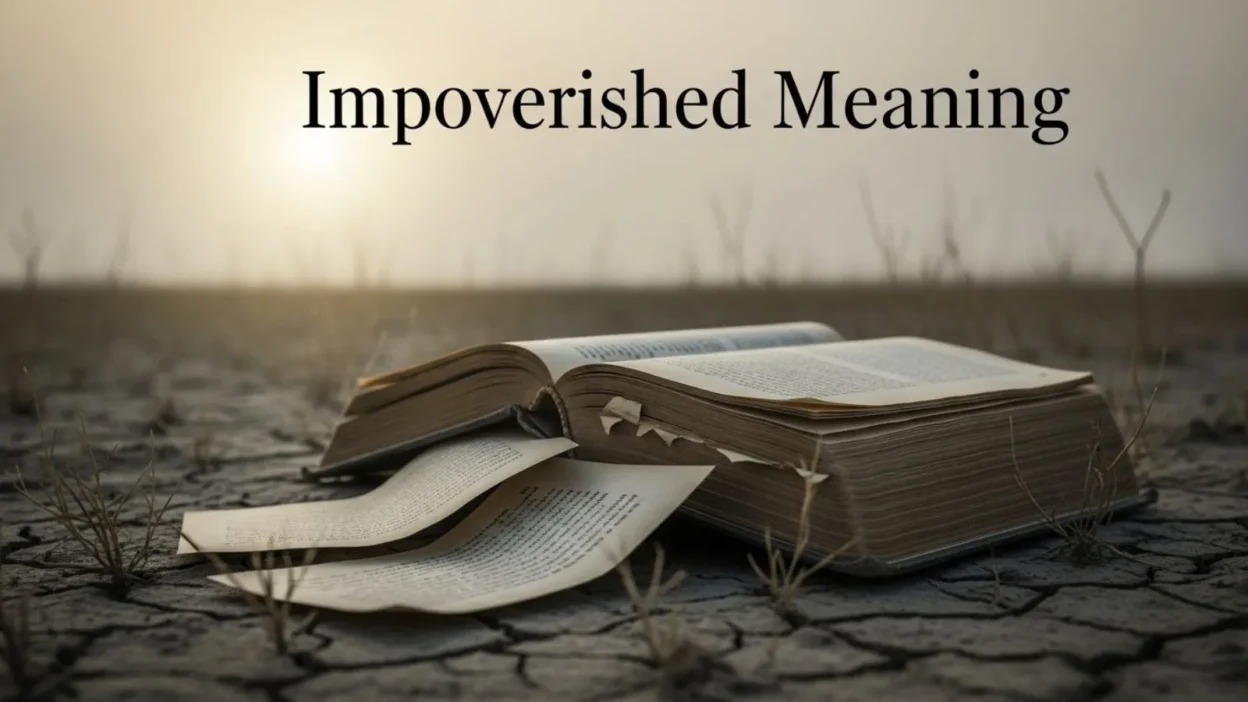
Understanding the term “impoverished” is essential for clear communication, whether in everyday conversation, writing, or literature.
At its core, impoverished refers to a state of lacking often financial resources but it can also describe situations, ideas, or environments that are limited in quality, richness, or vitality.
For example.
A community may be economically impoverished, a vocabulary may be intellectually impoverished, or soil may be environmentally impoverished.
By learning the full scope of its meaning, you not only expand your vocabulary but also gain the ability to describe situations more accurately and empathetically.
This article will explore the impoverished meaning in depth, covering its definitions, historical origins, synonyms, usage examples, and distinctions from similar terms like “poor” or underprivileged.
Whether you’re a student, writer, or curious reader, understanding “impoverished” will help you communicate more precisely and appreciate the nuances of the word in various contexts.
What Does Impoverished Mean?
The word “impoverished” primarily describes a state of being poor or lacking essential resources. In its most common usage, it refers to financial hardship, such as individuals, families, or communities struggling to meet basic needs like food, shelter, and clothing. For example, “The charity works to support impoverished families in rural areas.”
However, impoverished is not limited to describing financial poverty. It can also refer to anything that is lacking in quality, richness, or vitality. For instance, a writer may describe someone’s ideas as “intellectually impoverished,” meaning they are limited in creativity or depth. Similarly, in environmental contexts, soil that lacks nutrients can be called “impoverished soil,” emphasizing its inability to support healthy plant growth.
Using the word correctly requires understanding the context. While “poor” can often replace “impoverished” in casual conversation, impoverished carries a slightly more formal tone and can extend beyond financial contexts. It allows speakers and writers to convey not just material deficiency but also limitations in knowledge, culture, or resources.
In literature and media, impoverished often evokes empathy or a deeper understanding of a person or situation. By applying it thoughtfully, you can describe both tangible and intangible deficits with precision. For example, one might write, “Her vocabulary seemed impoverished compared to the rich language of her peers,” highlighting a lack in knowledge rather than money.
Origin and Etymology of “Impoverished”
The word “impoverished” has its roots in the Old French word impoverir, which means “to make poor,” and ultimately comes from the Latin improbare, meaning “to make worse” or “to weaken.” Over time, the word evolved in English to describe not only financial deprivation but also a general state of deficiency or lack.
In Middle English, impoverished was often used in literature and legal documents to describe people or communities that were deprived of wealth or resources. By the 17th and 18th centuries, the word had broadened in meaning to include intellectual and cultural contexts, such as describing ideas, language, or environments as lacking richness or substance.
The etymology of impoverished also highlights its connection to other words like poor and poverty, which share the same Latin root pauper. While poor is more commonly used in everyday speech, impoverished tends to carry a more formal or descriptive tone, making it useful in academic writing, literature, and journalism.
Understanding the origin of impoverished gives insight into its nuanced meaning. It conveys more than just the absence of money—it can reflect a lack of opportunity, knowledge, resources, or vitality. For example, an “impoverished landscape” may lack natural beauty, or an “impoverished argument” may lack logical strength. By knowing its history, writers and speakers can apply the term with precision, making their descriptions more vivid and accurate.
Synonyms and Antonyms of Impoverished
Understanding the synonyms and antonyms of impoverished helps expand your vocabulary and ensures precise usage in different contexts. Synonyms are words that share a similar meaning, while antonyms convey the opposite.
Synonyms
Some common synonyms of impoverished include:
- Poor – the most general term for lacking wealth.
- Destitute – emphasizes extreme poverty or absence of basic necessities.
- Underprivileged – often used to describe people or communities lacking social and economic advantages.
- Deprived – highlights the lack of access to essential resources or opportunities.
These synonyms can be used interchangeably in certain contexts, but subtle differences exist. For instance, destitute suggests a more severe level of poverty than impoverished, while underprivileged emphasizes societal or systemic limitations rather than just financial lack.
Antonyms
Common antonyms of impoverished include:
- Wealthy – having abundant financial resources.
- Affluent – often used to describe a high standard of living.
- Rich – simple and widely understood term for financial abundance.
- Prosperous – implies success and well-being beyond just money, often including health or growth.
Knowing these antonyms and synonyms allows you to choose words that match the tone and context of your writing. For example, you might write, “The impoverished village struggled to access clean water,” or contrast it with, “The affluent town enjoyed modern amenities.” Using precise alternatives helps make your writing richer and more impactful.
How to Use Impoverished in a Sentence
Using the word “impoverished” correctly in sentences can enhance your writing and communication, whether you are discussing financial situations, intellectual limitations, or other types of deficiencies. The key is to understand the context in which the word applies.
1. Financial or Material Context
When describing people, communities, or regions lacking basic resources, impoverished highlights economic hardship in a slightly more formal tone than “poor.”
- Example: “The charity aims to provide support for impoverished families in remote villages.”
- Example: “After the factory closed, the town became impoverished, struggling to find new employment.”
2. Intellectual or Cultural Context
Impoverished can also describe ideas, creativity, or knowledge that lack depth or richness.
- Example: “His argument was impoverished, failing to consider alternative viewpoints.”
- Example: “The essay was well-structured but impoverished in vocabulary, making it less engaging.”
3. Environmental or Material Deficiency
The word may apply to environments or materials that lack quality or resources.
- Example: “The garden suffered due to impoverished soil, producing few crops.”
- Example: “Overfishing has left the ecosystem impoverished, threatening biodiversity.”
Tips for Correct Usage
- Avoid using impoverished for casual conversation; it suits formal, academic, or literary contexts.
- Pair the word with nouns that reflect deficiency, such as community, idea, soil, culture, or vocabulary.
By using impoverished appropriately, you can convey both material and intangible lack with precision, adding depth and sophistication to your writing.
Impoverished vs. Poor: Difference Explained
Although “impoverished” and “poor” are often used interchangeably, there are subtle differences in meaning, tone, and usage. Understanding these distinctions will help you use each word more precisely.
1. Meaning and Tone
- Poor is a simple, widely recognized term that describes someone lacking money, resources, or basic necessities. It is commonly used in everyday conversation.
- Example: “Many people in the city live in poor conditions.”
- Impoverished carries a slightly more formal tone and can describe not only financial deprivation but also deficits in knowledge, culture, or quality. It often appears in literature, journalism, and academic writing.
- Example: “The novel portrays an impoverished society, struggling with both economic and educational hardships.”
2. Contextual Differences
- Poor generally focuses on material or economic lack. It is straightforward and informal.
- Impoverished is more versatile. It can describe:
- Financial situations: “The region became impoverished after the factory closed.”
- Intellectual or cultural lack: “The poem felt impoverished in imagery.”
- Environmental deficiency: “The farmland was impoverished due to overuse.”
3. Nuance in Writing
Using impoverished instead of “poor” adds depth and sophistication to your writing. It signals that you are describing more than just money—it can convey scarcity, limitation, or lack of richness in a broader sense.
Impoverished in Literature and Media
The word “impoverished” is frequently used in literature and media to convey more than just financial scarcity. Writers and journalists often use it to highlight emotional, intellectual, or cultural deprivation, adding depth and nuance to their descriptions.
In literature, impoverished can describe characters, societies, or environments to evoke empathy or illustrate struggle. For example, a novel might portray a town as impoverished, not only financially but also lacking in education, opportunity, or cultural richness. This usage helps readers understand the broader challenges characters face, making stories more engaging and realistic.
In media and journalism, the term often appears when discussing social issues. Articles might describe impoverished communities affected by natural disasters, economic downturns, or systemic inequality. The word signals not just the absence of money but also limited access to resources, education, and healthcare, giving readers a more complete understanding of the situation.
Impoverished is also used metaphorically in reviews or critiques. For instance, a film review might describe dialogue as “impoverished,” suggesting it lacks creativity or emotional impact, while a music review could describe an album as “impoverished in originality.”
By using impoverished thoughtfully, authors and journalists can convey complex deficiencies, whether material, intellectual, or cultural. Its versatility makes it a powerful word for adding precision, tone, and emotional resonance in writing, helping readers grasp both tangible and intangible forms of scarcity.
Impoverished in Society
In society, the term “impoverished” often goes beyond describing financial hardship to highlight broader social and systemic challenges. It refers not only to a lack of money but also to limited access to education, healthcare, opportunities, and resources, which can significantly affect individuals and communities.
For example, an impoverished community may face poor infrastructure, insufficient schools, and limited employment opportunities. Residents may struggle to meet basic needs, but the term also implies the broader lack of support systems and opportunities that prevent upward mobility. Using impoverished in this context emphasizes the multidimensional nature of poverty rather than focusing solely on income.
Social commentators and researchers also use impoverished to describe cultural or intellectual deficits within a society. For instance, areas with limited access to libraries, arts, or technology might be described as culturally or intellectually impoverished. This usage draws attention to the fact that poverty is not only about material wealth but also about access to knowledge, culture, and personal growth.
Furthermore, recognizing the impoverished conditions of a community can foster empathy and inspire action. Nonprofits, policymakers, and activists often use the term to advocate for social programs, educational reforms, and economic support. By understanding the societal implications of being impoverished, individuals can better appreciate the challenges faced by disadvantaged groups and contribute to meaningful solutions.
Common Misconceptions About the Term Impoverished
Many people misunderstand the term “impoverished,” assuming it refers only to financial poverty. While economic hardship is a significant aspect, impoverished can describe a broader range of deficiencies, including intellectual, cultural, or environmental scarcity. Recognizing these nuances helps avoid miscommunication and enriches your writing.
1. Misconception: Only Financial Poverty
A common misconception is that impoverished always means lacking money. While it often describes economically disadvantaged individuals or communities, it also applies to non-monetary contexts. For example:
- Impoverished vocabulary – lacking richness in language or expression.
- Impoverished soil – lacking nutrients to support healthy plant growth.
2. Misconception: Negative Judgment
Some people think using impoverished carries a moral judgment. In reality, it is a descriptive term, not an insult. It objectively highlights a lack or deficiency without assigning blame. For instance, “The region became impoverished after the natural disaster” describes circumstances, not character.
3. Misconception: Informal Usage
Another misunderstanding is that impoverished can be casually used in any conversation. The word is formal and best suited for academic, literary, or journalistic contexts. Using it in casual speech may sound awkward.
4. Misconception: Interchangeable with “Poor” Always
While poor and impoverished overlap, they are not always interchangeable. Impoverished often conveys a broader sense of limitation—cultural, intellectual, or environmental—not just financial.
FAQs About
Understanding the term “impoverished” can sometimes raise questions about its proper use, meaning, and context. Here are some frequently asked questions to clarify its nuances.
1. What does “impoverished” mean in simple words?
Impoverished means lacking something important. Most often, it refers to financial poverty, but it can also describe a lack of quality, richness, or resources in ideas, culture, or environments.
2. Can “impoverished” describe things other than people?
Yes. While commonly applied to people or communities, it can describe abstract or material things. Examples include:
- Impoverished soil – soil lacking nutrients.
- Impoverished ideas – concepts or arguments lacking depth or creativity.
- Impoverished culture – cultural environments lacking art, education, or exposure.
3. How is “impoverished” different from “poor”?
“Poor” typically refers to financial lack, while impoverished can describe material, intellectual, cultural, or environmental scarcity. Impoverished is slightly more formal and versatile, making it suitable for academic, literary, or professional contexts.
4. Can “impoverished” be used in literature and media?
Absolutely. Writers and journalists use impoverished to add depth, describing not just financial hardship but also limited resources, creativity, or opportunities, helping the audience understand complex situations.
5. Is using “impoverished” negative?
Not necessarily. It is descriptive rather than judgmental, highlighting a lack without assigning blame. Context matters, and it should be used thoughtfully to convey scarcity accurately.
Conclusion
The term “impoverished” is much more than a synonym for poor. While it often describes financial hardship, it can also refer to a lack of quality, richness, or resources in intellectual, cultural, or environmental contexts.
Understanding its full meaning allows you to use the word accurately and thoughtfully, whether in writing, conversation, or analysis.
By exploring its definitions, history, synonyms, and examples, we see that impoverished conveys both tangible and intangible forms of scarcity.
It adds nuance, sophistication, and precision to descriptions of people, communities, ideas, or environments. Using it correctly helps writers, students, and professionals communicate more clearly and empathetically.