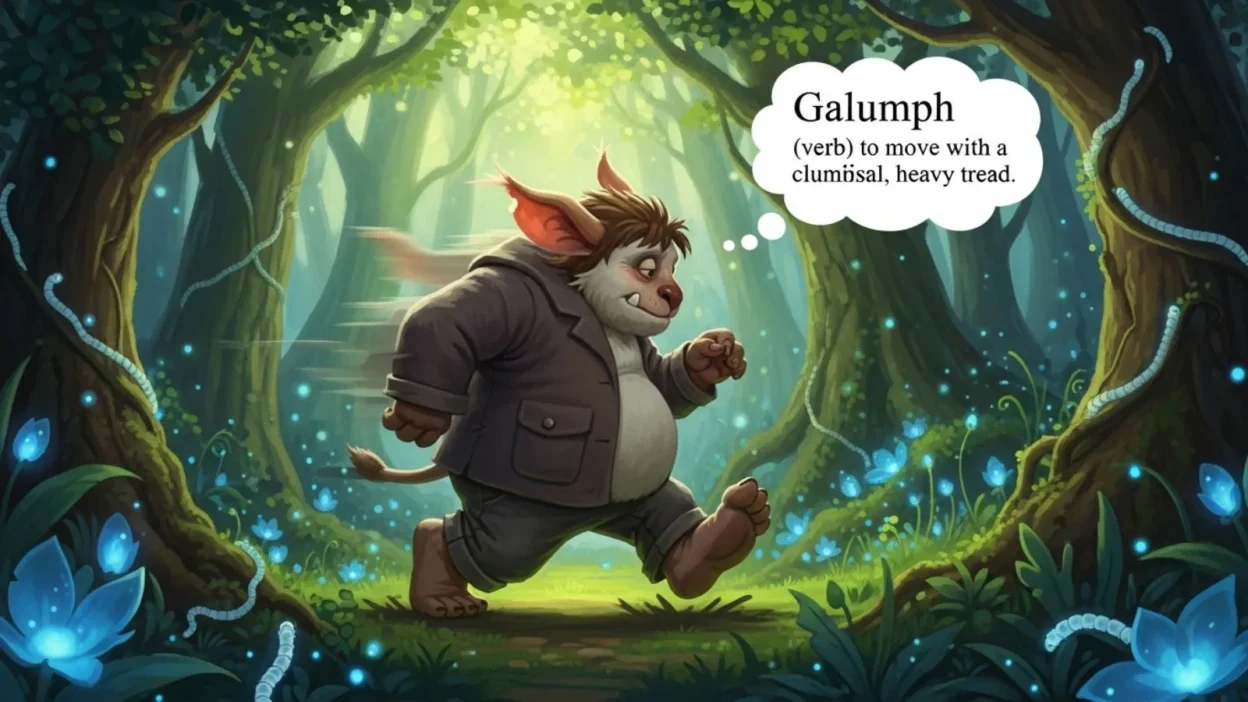
The word “galumph” is one of those quirky English words that instantly sparks curiosity and a smile. But what does galumph mean? In simple terms, it describes moving in a clumsy, noisy, or heavy way often with a sense of joy, triumph, or playful exaggeration.
Unlike ordinary verbs like “walk” or “stomp,” galumph carries personality, energy, and humor, making it a favorite among writers, storytellers, and word lovers. Its origin traces back to Lewis Carroll, who invented the word to add whimsy and vivid imagery to his works.
Today, galumph is more than just a literary word it’s a fun way to express exuberant motion in everyday life, creative writing, and even social media posts. In this article, we’ll explore the definition, pronunciation, origin, synonyms, and examples of galumph, helping you understand and use this playful word with confidence and style.
What Does Galumph Mean?
The word galumph is a verb that describes moving in a clumsy, noisy, or heavy way, often with a sense of excitement or triumph. Unlike regular verbs like “walk” or “run,” galumph adds character and vivid imagery to the action, making it more expressive and memorable. Imagine someone bursting into a room with such enthusiasm that their steps are loud and somewhat awkward—this is exactly the feeling galumph conveys.
One of the most interesting aspects of galumph is its playful tone. It doesn’t just mean “to move heavily”; it suggests a combination of joy, energy, and slight clumsiness, which makes the word humorous and endearing. For instance, you might say, “The kids galumphed across the playground, laughing and bumping into each other,” which instantly paints a lively picture in the reader’s mind.
In literature, galumph is often used to describe characters who are larger-than-life or full of exuberance. Its usage emphasizes movement with personality, rather than simple locomotion.
Synonyms and Nuances
Some synonyms include lumber, stomp, trudge, and plod, but these words often lack the playful or joyful tone that galumph carries. Conversely, antonyms like glide, tiptoe, or sneak describe quiet, graceful movement—the opposite of galumphing.
By understanding this definition, you can start using galumph to add humor, vivid imagery, and character to your writing or even describe everyday situations in a fun way.
The Origin of Galumph
The word galumph has a fascinating literary origin, tracing back to the brilliant imagination of Lewis Carroll, the author of Through the Looking-Glass (1871). Carroll was known for his playful use of language, coining words that captured whimsical ideas and lively actions. Galumph first appeared in his writings as part of this creative language play, combining sounds and rhythm to convey both motion and emotion.
Scholars suggest that Carroll likely blended elements of the words “gallop” and “triumph” to create galumph, giving it the sense of joyful, energetic, or triumphant movement. Unlike ordinary verbs, which simply describe action, Carroll’s words often painted a vivid mental image, and galumph was no exception. It wasn’t just about moving; it was about moving with personality and flair.
Over time, galumph moved beyond literature and entered everyday English, particularly among word enthusiasts, writers, and educators. It remains a favorite example of a playful, expressive English verb that captures both action and emotion. Even today, dictionaries recognize galumph for its unique combination of clumsiness and exuberance, highlighting its literary roots and creative appeal.
Understanding the origin of galumph gives readers more than a definition—it provides context for how the word can be used to enrich writing, storytelling, and even casual conversation. By appreciating its whimsical beginnings, you can better embrace the joyful, playful energy embedded in the word.
Pronunciation of Galumph
Understanding how to pronounce galumph correctly is key to using the word confidently in speech and writing. The standard pronunciation is /ɡəˈləmf/, which can be broken down into three parts:
- “Guh” (/ɡə/) – a soft “g” sound followed by a short “uh.”
- “Luhm” (/ləm/) – a light, almost muted middle syllable.
- “F” (/f/) – a sharp ending, making the word punchy and energetic.
When said aloud, galumph should sound playful yet assertive, reflecting the clumsy but joyful motion it describes. A helpful trick is to think of it as a combination of “gallop” and “triumph,” which echoes its original literary roots.
Tips for Remembering Pronunciation
- Break it into syllables: Guh-lum-f.
- Emphasize the second syllable: **guh-**LUM-f.
- Repeat it while imagining someone moving with exaggerated, cheerful steps, as this reinforces both meaning and sound.
Practical Usage in Speech
- “He galumphed into the room, knocking over a stack of papers.”
- “The puppy galumphed across the yard, tail wagging wildly.”
Using the word correctly in conversation not only demonstrates vocabulary mastery but also adds humor and vivid imagery. Pronouncing galumph with confidence can make storytelling more lively, entertaining, and memorable.
Synonyms and Antonyms of Galumph
Understanding the synonyms and antonyms of galumph can help you use the word more precisely and enrich your vocabulary. While galumph refers to moving in a clumsy, noisy, or heavy way, other words capture similar actions, though with subtle differences in tone or imagery.
Synonyms of Galumph
Some common synonyms include:
- Lumber – to move heavily and clumsily, often slowly.
- Stomp – to move with forceful, loud steps.
- Trudge – to walk laboriously or with effort, usually in fatigue.
- Plod – to move slowly and heavily, sometimes monotonously.
While these words overlap with galumph, they often lack the playful or joyful undertone that galumph carries. For example, “He lumbered across the hall” sounds serious, while “He galumphed across the hall” evokes humor and energy.
Antonyms of Galumph
Antonyms highlight opposite types of movement:
- Glide – to move smoothly and gracefully.
- Tiptoe – to walk quietly and delicately.
- Sneak – to move stealthily and silently.
These antonyms emphasize subtlety, elegance, or caution—qualities absent in the exuberant clumsiness of galumph.
How to Use Galumph in a Sentence
One of the best ways to truly understand a word is to see it in action. Galumph is a playful verb that describes moving in a clumsy, noisy, or exuberant way, so it works perfectly in sentences that convey humor, excitement, or personality.
Everyday Examples
- “The children galumphed across the playground, laughing and tumbling over each other.”
- “He galumphed into the kitchen, eager to taste the fresh cookies.”
- “The dog galumphed down the hallway, knocking over a vase in his excitement.”
These examples show that galumph conveys motion with energy and a touch of clumsiness, making the scene vivid and entertaining.
Literary Examples
In literature, galumph is often used to add humor and character to descriptions:
- “The knight galumphed into the hall, armor clanging, yet triumphant.”
- “She galumphed across the stage, waving to the audience with exaggerated flair.”
Tips for Using Galumph
- Use it to replace ordinary verbs like walk, run, or stomp when you want exaggeration and fun.
- Pair it with descriptive context (sound, surroundings, or emotion) to make the movement come alive.
- Remember, galumph works best in informal, creative, or literary writing—its playful tone may not suit formal contexts.
By incorporating galumph into your sentences, you can make your writing more expressive, humorous, and memorable, giving everyday actions a lively, imaginative twist.
Fun Facts About Galumph
The word galumph is more than just a quirky English verb—it comes with a host of fun facts that make it even more interesting. For starters, it was coined by Lewis Carroll, the same author who gave the world the famous nonsense poem Jabberwocky. Carroll loved inventing words, and galumph was part of his playful exploration of language, blending humor, rhythm, and vivid imagery.
Pop Culture and Modern Usage
Although it began in literature, galumph has appeared in pop culture as well. Cartoon characters, children’s books, and comedy sketches often use the word to describe clumsy or enthusiastic movements. Its playful nature makes it ideal for storytelling, humor writing, and even social media captions, where exaggeration and humor are key.
Why People Love Galumph
- Expressive: It conveys not just movement but emotion and personality.
- Humorous: The word itself sounds funny, adding charm to any sentence.
- Memorable: Readers and listeners rarely forget it once they hear it.
Interesting Linguistic Insight
The word galumph is an example of a “nonce word”—a word created for a specific occasion but often lasting because of its appeal. Its combination of sound and meaning makes it highly versatile, from describing pets bounding around the house to characters storming onto a stage.
Galumph in Literature and Storytelling
The word galumph shines in literature and storytelling because it goes beyond simply describing movement—it adds humor, energy, and personality to characters and scenes. First introduced by Lewis Carroll in Through the Looking-Glass, it captured the playful, imaginative style that defined his writing. Carroll’s use of the word set a precedent for later authors who wanted to convey exuberant or clumsy motion with flair.
In stories, galumph often appears when a character is excited, triumphant, or unaware of their surroundings. For example, a heroic knight might galumph into a hall, armor clanking, emphasizing both strength and clumsiness, or a child might galumph down the stairs, bursting with enthusiasm. Unlike ordinary verbs like “walk” or “run,” galumph communicates personality and emotion, making scenes more vivid and memorable.
Poets and children’s authors also love galumph because it creates a rhythmic and playful tone. It can be used to describe animals, fantastical creatures, or even everyday people, adding a layer of whimsy that engages readers.
Using galumph in storytelling allows writers to create a visual and emotional impact with minimal words. The reader doesn’t just know what a character is doing—they can imagine the noise, awkwardness, and energy of the movement. This makes galumph a valuable tool for anyone aiming to make their writing lively, humorous, and unforgettable.
Galumph vs Other Funny English Words
English is full of playful, quirky words, and galumph fits perfectly among them. While it describes clumsy, noisy, or exuberant movement, other words capture different kinds of humor, surprise, or whimsical behavior. Comparing galumph with similar words helps highlight its unique charm and usage.
Galumph vs Bamboozle
- Galumph is about movement—energetic, clumsy, and fun.
- Bamboozle is about trickery or deception, often playful or humorous.
- Example: “The puppy galumphed across the yard” vs. “The magician bamboozled the audience with sleight of hand.”
Galumph vs Kerfuffle
- Galumph conveys physical action.
- Kerfuffle refers to a commotion, fuss, or minor conflict.
- Example: “He galumphed into the room” vs. “A kerfuffle broke out over the missing keys.”
Galumph vs Gobsmacked
- Galumph expresses joyful or clumsy movement.
- Gobsmacked means astounded or shocked, usually emotionally rather than physically.
Why Galumph Stands Out
While many quirky English words are about emotions, chaos, or surprise, galumph uniquely blends action with humor. It not only tells readers what someone is doing but also conveys their energy, personality, and sometimes silliness. This makes it ideal for creative writing, storytelling, and playful descriptions.
Tips to Remember and Use Galumph
Using galumph effectively requires understanding both its meaning and playful tone. Here are practical tips to help you remember, pronounce, and incorporate this fun word into your writing or conversation.
1. Visualize the Action
A great way to remember galumph is by picturing someone moving clumsily but joyfully. Imagine a child running into a room, arms flailing, or a dog bounding across the yard with excitement. Visual associations make both the meaning and pronunciation stick in your memory.
2. Break It Into Syllables
Pronounce it as Guh-lum-f (/ɡəˈləmf/). Emphasize the middle syllable “LUM” to give it rhythm and energy. Saying it aloud while imagining someone galumphing can reinforce both sound and meaning.
3. Pair With Context
Use galumph in sentences with descriptive context.
Example:
- “He galumphed across the stage, nearly tripping over the props.”
- “The children galumphed down the hill, laughter echoing through the park.”
Context helps the word come alive and makes your writing more vivid.
4. Compare With Similar Words
Think of synonyms like lumber, stomp, and trudge, and notice how galumph differs—it’s more playful, exaggerated, and energetic. Recognizing this nuance helps you choose the right word for your tone.
5. Practice in Writing and Speech
Try using galumph in social media captions, storytelling, or informal writing. The more you practice, the easier it becomes to recall and use naturally.
FAQs About Galumph
1. What does galumph mean in modern English?
Galumph is a verb that describes moving in a clumsy, noisy, or heavy way, often with a sense of joy, excitement, or triumph. It’s playful, humorous, and adds personality to writing or speech.
2. Is galumph formal or informal?
Galumph is considered informal and playful. It’s perfect for creative writing, storytelling, and casual conversation, but it’s generally not used in formal documents or professional reports.
3. How do you pronounce galumph?
The correct pronunciation is /ɡəˈləmf/. Break it into syllables: Guh-lum-f, with emphasis on the middle syllable “LUM.” Saying it aloud while imagining clumsy or energetic movement helps reinforce pronunciation.
4. Can you use galumph in everyday sentences?
Yes! Examples include:
- “The dog galumphed across the living room, tail wagging wildly.”
- “She galumphed into the kitchen, eager to see the surprise.”
These show that the word works well to describe animated, clumsy, or enthusiastic movement.
5. What are synonyms and antonyms of galumph?
Synonyms: lumber, stomp, trudge, plod.
Antonyms: glide, tiptoe, sneak.
Synonyms describe heavy or clumsy motion, while antonyms describe quiet or graceful movement.
6. Where did galumph come from?
The word was coined by Lewis Carroll in Through the Looking-Glass (1871). It is a playful blend, possibly inspired by “gallop” and “triumph,” emphasizing clumsy but joyous motion.
Conclusion
The word galumph is a playful, expressive, and memorable verb that brings movement and personality to both writing and speech.
Originating from Lewis Carroll’s imagination, it describes moving in a clumsy, noisy, or exuberant way, often conveying joy, excitement, or triumph.
Unlike ordinary verbs, galumph adds humor, vivid imagery, and energy, making everyday actions or literary scenes more lively and engaging.
By learning its definition, pronunciation, origin, synonyms, and examples, you can confidently use galumph in sentences, storytelling, or even casual conversation.
Pairing it with context and imagination allows you to paint a visual and emotional picture, whether describing children, pets, or characters in a story.

Jonathan Bishopson is the punmaster-in-chief at ThinkPun.com, where wordplay meets wit and every phrase gets a clever twist. Known for turning ordinary language into laugh-out-loud lines, Jonathan crafts puns that make readers groan, grin, and think twice. When he’s not busy bending words, he’s probably plotting his next “pun-derful” masterpiece or proving that humor really is the best re-word.