
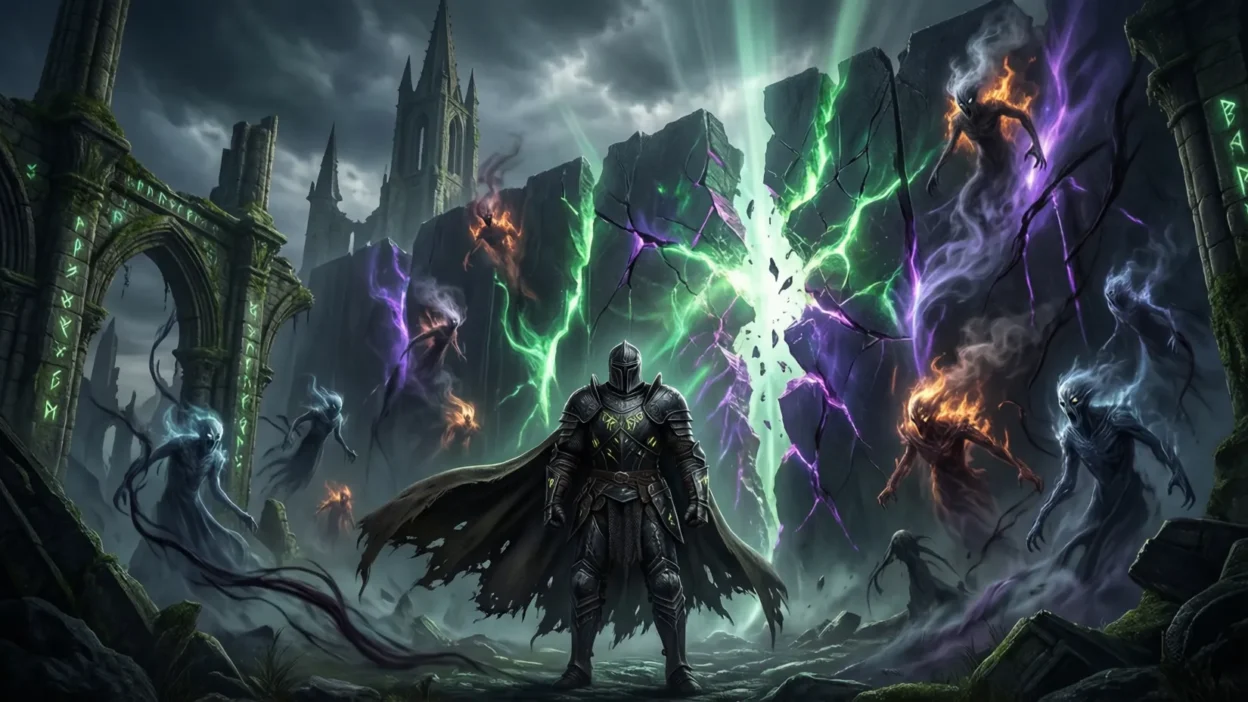
The Veilguard marks a pivotal moment for BioWare’s iconic fantasy RPG series. Set in the aftermath of Dragon Age: Inquisition and its Trespasser DLC, the game returns players to the fractured world of Thedas at a time when the Veil—the fragile barrier between reality and the Fade—stands on the brink of collapse.
At the center of this looming crisis is Solas, the Dread Wolf, whose plans threaten to reshape the world in ways both catastrophic and deeply personal.
Unlike previous entries, The Veilguard shifts focus away from world-saving institutions and places it on a smaller, more agile group of heroes operating in the shadows.
This change signals a renewed emphasis on character-driven storytelling, tighter combat, and meaningful player choice.
For longtime fans, it represents the continuation of long-running lore threads; for newcomers, it offers a fresh entry point into Dragon Age’s rich dark fantasy universe.
What Is Dragon Age: The Veilguard?
Dragon Age: The Veilguard is the fourth mainline entry in BioWare’s long-running fantasy RPG franchise and a direct narrative continuation of Dragon Age: Inquisition. Designed as a single-player, story-driven role-playing game, it places heavy emphasis on character relationships, impactful choices, and a more intimate scale than its predecessor. While the fate of Thedas once again hangs in the balance, the approach this time is notably different.
Rather than leading a massive organization like the Inquisition, players take on the role of a new protagonist—someone operating outside traditional power structures. This character becomes part of the Veilguard, a small but determined group tasked with confronting threats tied to the weakening Veil and the chaos spilling from the Fade. This narrative shift allows the story to explore events from a ground-level perspective, focusing on personal stakes as much as world-altering consequences.
From a gameplay standpoint, The Veilguard represents an evolution of the Dragon Age formula. BioWare has leaned into a more action-oriented combat system while retaining core RPG elements such as class choice, party synergy, and build customization. Exploration is designed to be more focused and deliberate, prioritizing handcrafted environments and narrative density over sheer scale.
Thematically, the game dives deep into questions of legacy, rebellion, and the cost of tearing down systems built on ancient lies. With its blend of high fantasy, political intrigue, and emotionally driven storytelling, Dragon Age: The Veilguard aims to honor the series’ roots while redefining what a modern Dragon Age experience can be.
Story & Narrative Foundations
At its core, Dragon Age: The Veilguard is a story about consequences—both long-buried and newly forged. The narrative unfolds in a Thedas still reeling from the revelations and choices made during Dragon Age: Inquisition, particularly the truth surrounding Solas and the ancient elven gods. The Veil, once believed to be a necessary safeguard, is now revealed as a fragile construct whose existence has suppressed entire cultures and histories. As cracks begin to form, the world edges closer to chaos.
Solas stands as the central narrative force, not merely as an antagonist, but as a deeply conflicted figure driven by regret, conviction, and a desire to restore what he believes was stolen from his people. His actions set the stage for a conflict that challenges traditional notions of heroism and villainy. Players are not simply tasked with stopping a threat, but with grappling with the moral weight of opposing—or understanding—his vision.
The story places significant emphasis on player agency. Dialogue choices, alliances, and moral decisions influence how factions respond and how companions perceive the protagonist. Rather than presenting clear-cut solutions, The Veilguard leans into ambiguity, forcing players to confront the uncomfortable reality that saving the world may require compromise, sacrifice, or even the destruction of familiar truths.
Through its narrative design, the game aims to deliver a darker, more personal Dragon Age experience—one where the fate of Thedas is inseparable from the relationships you forge and the ideals you choose to uphold.
Gameplay Evolution & Core Systems
Dragon Age: The Veilguard introduces a notable evolution in gameplay, reflecting BioWare’s intent to modernize the series while preserving its RPG identity. The most significant change lies in combat, which adopts a faster, more action-oriented approach compared to earlier entries. Players engage enemies in real time, relying on positioning, timing, and ability synergy rather than frequent tactical pauses. This shift is designed to make encounters feel more immediate and visceral, while still rewarding strategic thinking.
Despite the increased emphasis on action, party-based mechanics remain central to the experience. Players are accompanied by a smaller, more focused group of companions, each with distinct combat roles and abilities. While direct control over party members is more limited, issuing commands and coordinating skills is still essential for overcoming tougher encounters. Successful combat often depends on combining abilities—such as crowd control, elemental effects, and finishing moves—to exploit enemy weaknesses.
Beyond combat, the core gameplay loop balances exploration, narrative interaction, and character progression. Areas are crafted to encourage deliberate exploration, with environmental storytelling, hidden lore, and optional challenges rewarding attentive players. Character progression centers on class-based skill trees, allowing players to tailor their playstyle through specialized abilities and passive bonuses.
Overall, The Veilguard aims to strike a balance between accessibility and depth. By streamlining systems without stripping away meaningful choice, the game seeks to appeal to both longtime Dragon Age fans and newcomers looking for a polished, character-driven action RPG experience.
Companions, Relationships & Player Choice
Companions have always been the heart of the Dragon Age series, and The Veilguard continues this tradition with a renewed focus on depth over quantity. Rather than assembling a large roster, the game emphasizes a smaller group of richly developed characters, each with their own motivations, beliefs, and personal conflicts. These companions are not just combat allies, but fully realized individuals whose stories unfold alongside the main narrative.
Each companion is closely tied to the world’s factions and ongoing political tensions, offering unique perspectives on the unfolding crisis surrounding the Veil. Through conversations, personal quests, and pivotal story moments, players gain insight into their backgrounds and values. Decisions made throughout the game directly influence companion approval, shaping how they respond to the protagonist and to key events in the story.
Romance plays a significant role in relationship development, offering optional, fully voiced storylines that evolve naturally over time. These relationships are built on trust, shared values, and meaningful choices rather than simple dialogue triggers. Romantic and platonic bonds alike can have lasting consequences, affecting companion loyalty and even altering the course of certain narrative outcomes.
Player choice extends beyond individual relationships into broader moral and political decisions. Companions may disagree with the player’s actions, challenge their beliefs, or even withdraw support if pushed too far. This dynamic reinforces one of The Veilguard’s central themes: leadership is not about universal approval, but about standing by the consequences of your convictions.
World Design, Exploration & Atmosphere
The world of Dragon Age: The Veilguard is designed to feel dense, reactive, and steeped in history. Instead of relying on massive open-world zones, the game focuses on carefully crafted environments that emphasize narrative detail and purposeful exploration. Each location is built to reflect the political, cultural, and magical tensions tearing at Thedas, making the world itself an active participant in the story.
Exploration rewards curiosity rather than scale. Players uncover hidden paths, secret encounters, and lore-rich areas that expand understanding of the Veil, the Fade, and the civilizations shaped by them. Environmental storytelling plays a major role, with abandoned ruins, corrupted landscapes, and occupied settlements visually conveying the consequences of magical instability and political conflict.
Atmosphere is further reinforced through lighting, sound design, and environmental effects. The weakening of the Veil manifests in subtle but unsettling ways—distortions in reality, echoes from the Fade, and sudden shifts in tone that remind players of the fragile boundary between worlds. These elements help maintain a sense of unease and urgency, even during quieter moments.
Hub areas serve as central points for progression, conversation, and planning. These spaces evolve over time, reflecting the player’s choices and the broader state of the world. By grounding exploration in narrative context, The Veilguard creates a world that feels lived-in and responsive, reinforcing the game’s focus on immersion, consequence, and meaningful discovery rather than sheer size.
Classes, Progression & Character Customization
Character progression in Dragon Age: The Veilguard is built around flexibility and identity, allowing players to shape a protagonist that feels both mechanically effective and narratively personal. The game retains the series’ classic class framework—Warrior, Rogue, and Mage—while reworking how each plays within the more action-focused combat system. Each class offers a distinct fantasy, emphasizing different approaches to combat, mobility, and battlefield control.
Progression is driven by expansive skill trees that blend active abilities with passive bonuses. Rather than forcing players into rigid roles, the system encourages experimentation and specialization. Warriors can lean into defensive durability or aggressive frontline damage, Rogues may focus on precision strikes or evasive tactics, and Mages can tailor their abilities around elemental control, support, or raw destructive power. These choices significantly affect moment-to-moment gameplay.
Customization extends beyond abilities into gear and visual identity. Weapons and armor not only influence stats but also reinforce class playstyles and character themes. Equipment upgrades and crafting options allow players to refine their builds over time, rewarding investment and exploration. Visual customization ensures that progression feels tangible, with armor and weapons reflecting the character’s growth and status.
Importantly, progression is tied to player choice rather than grind. Experience, upgrades, and new abilities are earned through story advancement, meaningful encounters, and exploration. This approach keeps the focus on narrative momentum while still offering deep RPG systems, ensuring that character growth feels earned, impactful, and closely aligned with the story being told.
Why Dragon Age: The Veilguard Matters
Dragon Age: The Veilguard represents more than just the next chapter in a beloved RPG franchise—it is a defining moment for both Dragon Age and BioWare as a studio. After years of shifting industry trends and mixed receptions to previous releases, the game signals a clear return to what originally set BioWare apart: character-driven storytelling, morally complex narratives, and worlds shaped by player choice.
For longtime fans, The Veilguard addresses lingering questions left unresolved since Inquisition and its Trespasser DLC. The story’s focus on Solas, the Veil, and the truth behind ancient elven history brings years of lore development to a critical turning point. Rather than resetting the narrative, the game embraces its past, rewarding players who have invested in the series while still remaining accessible to newcomers.
From a design perspective, the shift toward a more focused structure reflects a broader industry reassessment of open-world excess. By prioritizing handcrafted environments, tighter combat, and deeper companion interactions, The Veilguard positions itself alongside modern RPGs that value quality over scale. This approach allows for stronger pacing and more emotionally resonant storytelling.
Ultimately, the success of Dragon Age: The Veilguard will influence the future of BioWare’s single-player RPGs. It stands as a test of whether the studio can evolve its mechanics without losing its narrative soul—and whether Dragon Age can once again set the standard for immersive, choice-driven fantasy storytelling.
Conclusion:
As Dragon Age: The Veilguard approaches release, expectations are understandably high. For many players, this game represents a reunion with a series defined by its emotional depth, moral ambiguity, and unforgettable characters.
BioWare’s design choices suggest a deliberate effort to learn from past successes and shortcomings, blending modern action-RPG sensibilities with the narrative complexity that long defined the studio’s identity.
Players should expect a more intimate Dragon Age experience—one that values focused storytelling over sprawling excess.
The reduced scale does not mean reduced ambition; rather, it allows the game to explore its themes with greater clarity and emotional weight.
Choices are presented not as binary decisions, but as layered dilemmas with lasting consequences, reinforcing the idea that every victory comes at a cost.
For newcomers, The Veilguard offers a strong entry point into Thedas. While it builds upon established lore, its new protagonist and perspective make the story approachable without requiring exhaustive knowledge of past games.
For veterans, the payoff lies in seeing long-running narrative threads reach meaningful conclusions.
Ultimately, Dragon Age: The Veilguard aims to reaffirm why the series matters. If it succeeds, it will stand as a reminder that role-playing games thrive not on scale alone, but on well-written characters, thoughtful worldbuilding, and the power of choice.
Whether it becomes a defining RPG of its generation will depend on execution—but its vision is unmistakably Dragon Age at its core.

Jonathan Bishopson is the punmaster-in-chief at ThinkPun.com, where wordplay meets wit and every phrase gets a clever twist. Known for turning ordinary language into laugh-out-loud lines, Jonathan crafts puns that make readers groan, grin, and think twice. When he’s not busy bending words, he’s probably plotting his next “pun-derful” masterpiece or proving that humor really is the best re-word.