
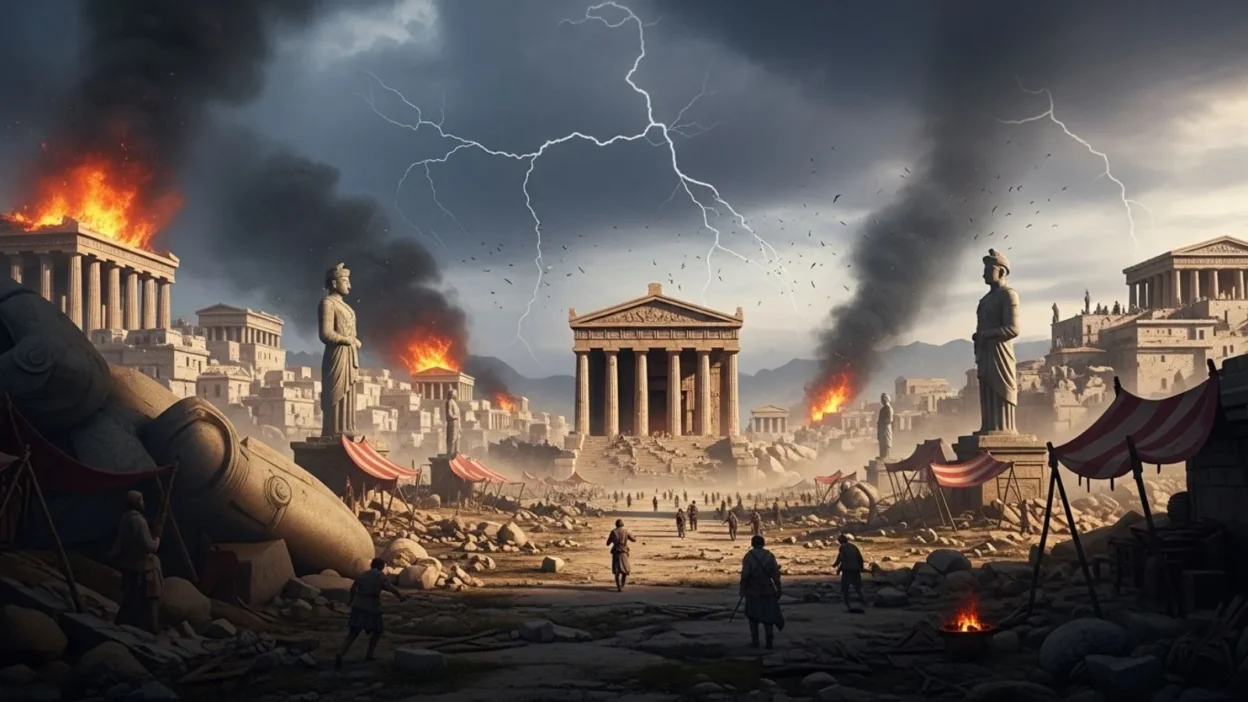
The Bronze Age Collapse, occurring around 1200 BCE, marks one of the most mysterious and transformative periods in ancient history.
During this time, several powerful civilizations across the Eastern Mediterranean including the Mycenaeans, Hittites, and the Egyptian New Kingdom experienced sudden decline or complete collapse.
Palaces were destroyed, trade networks disrupted, and literacy vanished in many regions, ushering in the s called Dark Age.
Historians and archaeologists have long debated the causes of this widespread upheaval, pointing to a combination of climate change, invasions by the Sea Peoples, internal revolts, and economic disruptions.
Understanding the Bronze Age Collapse is crucial not only for grasping the fragility of ancient civilizations but also for learning lessons about societal resilience and interconnected systems.
In this article, we will explore the timeline, causes, affected civilizations, evidence, theories, and lasting impact of this remarkable period in human history.
What Was the Bronze Age?
The Bronze Age, which spanned roughly from 3300 BCE to 1200 BCE, was a transformative era in human history, marked by the widespread use of bronze for tools, weapons, and art. Bronze, an alloy of copper and tin, was stronger and more durable than stone, enabling societies to advance technologically, militarily, and culturally. This period saw the rise of complex civilizations across the Eastern Mediterranean and Near East, including Egypt’s New Kingdom, the Hittite Empire, Mycenaean Greece, and Mesopotamian city-states.
These civilizations were interconnected through extensive trade networks, exchanging not only raw materials like tin, copper, and gold, but also ideas, technologies, and cultural practices. The development of writing systems, such as Egyptian hieroglyphs, Hittite cuneiform, and Linear B in Mycenaean Greece, facilitated record-keeping, administration, and communication across vast empires.
Societies during the Bronze Age were organized around palace economies and centralized governance, which coordinated agriculture, trade, and military activities. Urban centers thrived, monumental architecture was constructed, and art and craftsmanship flourished.
However, despite these advancements, these civilizations were highly interdependent, meaning that disruptions—whether environmental, social, or economic—could have cascading effects. This interconnectedness ultimately made them vulnerable to collapse, setting the stage for the dramatic events of the late Bronze Age. Understanding the foundations of the Bronze Age helps explain why the sudden decline around 1200 BCE had such a profound and widespread impact across the ancient world.
Timeline of the Bronze Age Collapse
The Bronze Age Collapse occurred approximately between 1200 BCE and 1150 BCE, marking a period of sudden and widespread decline across the Eastern Mediterranean. While the exact timeline varies by region, historians have identified a series of key events that signal the unraveling of several powerful civilizations.
In Greece, the Mycenaean palaces—once thriving centers of administration and trade—were systematically destroyed or abandoned. Sites such as Pylos, Tiryns, and Mycenae show evidence of fire and sudden depopulation, accompanied by the disappearance of the Linear B writing system, signaling the collapse of bureaucratic structures.
The Hittite Empire, centered in modern-day Turkey, also fell around this time. Its capital, Hattusa, was abandoned, and records indicate internal turmoil and external attacks. Meanwhile, in Egypt, the New Kingdom under Ramesses III faced invasions from the Sea Peoples, which strained the military and economy, even though Egypt managed to survive the period better than its neighbors.
Other regions, including the Levant and parts of Mesopotamia, saw urban decline, depopulation of major cities, and interruptions in trade networks. The collapse was not a single catastrophic event but a series of overlapping crises, including warfare, famine, and political instability.
This timeline highlights the synchronized nature of the collapse, showing that multiple civilizations—despite being geographically separate—were interconnected and vulnerable to systemic failures. The period marked the transition from the Bronze Age to the Iron Age, reshaping the political, economic, and cultural landscape of the ancient world.
Causes of the Bronze Age Collapse
The Bronze Age Collapse was likely caused by a combination of interconnected factors rather than a single event. Historians and archaeologists have identified several major contributors that together led to the downfall of multiple civilizations around 1200 BCE.
One significant factor was climate change. Evidence from tree rings, sediment cores, and pollen studies suggests prolonged droughts and food shortages in the Eastern Mediterranean, which would have undermined agriculture and weakened city-states. Reduced crop yields could have triggered famine, social unrest, and migrations, destabilizing entire regions.
Another key factor was the invasion of the Sea Peoples, a confederation of raiders whose attacks on Egypt, the Levant, and Hittite territories caused widespread destruction. These invasions disrupted trade networks and destabilized already weakened political systems.
Internal rebellions and political instability also played a role. Many palace-centered economies, such as in Mycenaean Greece and the Hittite Empire, relied on centralized administration. When central authority weakened, it led to social unrest and collapse.
Economic disruption further exacerbated the crisis. The interconnected trade of bronze, tin, and other resources broke down, limiting access to essential materials for weapons and tools.
Some scholars also point to systemic societal collapse, where a chain reaction of failures—political, economic, and environmental—spread across regions.
In reality, the Bronze Age Collapse was likely a “perfect storm” of these factors. The combination of climate stress, invasions, internal turmoil, and trade disruption demonstrates how interconnected ancient civilizations were and how vulnerable they could be to widespread, simultaneous crises.
Civilizations Affected
The Bronze Age Collapse had a profound impact on multiple civilizations across the Eastern Mediterranean and Near East. While some societies survived in a weakened form, others were completely abandoned, marking the end of their prominence in history.
In Mycenaean Greece, palatial centers such as Pylos, Mycenae, and Tiryns were destroyed, likely by a combination of invasions and internal uprisings. The collapse resulted in the loss of the Linear B writing system, effectively ending complex record-keeping and administrative control. Many Mycenaean cities were abandoned, and Greek society entered a period often referred to as the “Greek Dark Ages.”
The Hittite Empire, centered in modern-day Turkey, faced a similar fate. Its capital, Hattusa, was destroyed, and records indicate both external attacks and internal political turmoil. The fall of the Hittites left Anatolia fragmented, disrupting trade routes and regional stability.
In Egypt, the New Kingdom faced invasions by the Sea Peoples under Pharaoh Ramesses III. Although Egypt managed to survive the crisis, it experienced significant economic strain, military losses, and weakening of centralized authority.
Other regions, including the Levant and Mesopotamia, saw urban decline and the abandonment of major cities. Trade networks collapsed, leading to shortages of essential goods like tin and copper, which were crucial for bronze production.
Overall, the Bronze Age Collapse illustrates how interconnected civilizations were, as the downfall of one society often triggered instability in neighboring regions. The widespread impact reshaped political, economic, and cultural landscapes, paving the way for the Iron Age and the rise of new civilizations.
Evidence of the Collapse
The Bronze Age Collapse is supported by a wealth of archaeological and historical evidence, providing insight into the dramatic changes that swept across the Eastern Mediterranean around 1200 BCE. Excavations at key sites reveal clear signs of destruction, abandonment, and social disruption.
In Greece, Mycenaean palaces such as Pylos, Tiryns, and Mycenae show destruction layers marked by fire and structural collapse, indicating violent events or invasions. Additionally, the disappearance of Linear B tablets demonstrates the sudden loss of administrative and bureaucratic systems.
The Hittite Empire left behind records of turmoil, including diplomatic correspondence and cuneiform tablets that mention attacks and internal instability. The abandonment of Hattusa, the Hittite capital, provides strong physical evidence of societal collapse.
In Egypt, inscriptions describe conflicts with the Sea Peoples, while archaeological layers in coastal cities show fortifications and signs of battle. Although Egypt survived, its records document the economic strain and societal stress caused by these invasions.
Other regions, including the Levant and Mesopotamia, show a decline in urban settlements, trade goods, and cultural artifacts. Archaeologists note that cities were abandoned, fortifications destroyed, and long-distance trade disrupted, particularly in bronze and tin, which were essential for weaponry and tools.
Natural evidence also supports environmental stress as a contributing factor. Pollen analysis, tree rings, and sediment cores indicate drought and climate shifts during this period, which would have undermined agriculture and food security.
Together, these findings form a multi-faceted picture of the Bronze Age Collapse, combining evidence of warfare, environmental stress, and economic breakdown, helping historians reconstruct this pivotal turning point in ancient history.
Theories and Debates
The Bronze Age Collapse has sparked extensive scholarly debate, with historians and archaeologists proposing multiple theories to explain why several advanced civilizations suddenly fell around 1200 BCE. Most agree that the collapse was multi-causal, rather than the result of a single factor.
One prominent theory emphasizes invasions by the Sea Peoples, who attacked Egypt, the Levant, and Hittite territories. Proponents argue that these raids disrupted trade networks, destroyed cities, and destabilized political systems. However, critics point out that invasions alone may not explain the simultaneous collapse across so many regions.
Another explanation focuses on climate change. Evidence from drought indicators, pollen analysis, and tree rings suggests prolonged periods of reduced rainfall, leading to crop failures and famine. Environmental stress likely weakened societies, making them more vulnerable to other pressures.
Internal rebellions and societal unrest also play a key role. In highly centralized palace economies, such as those in Mycenaean Greece and the Hittite Empire, political instability or civil uprisings could have triggered cascading collapses.
Economic disruption is another critical factor. The collapse of long-distance bronze trade, especially in tin and copper, would have severely impacted weapon production, tools, and overall technological stability.
Modern debates often revolve around the “domino effect” theory, suggesting that interconnected civilizations fell in succession due to systemic vulnerabilities. While there is no single consensus, most scholars agree that the Bronze Age Collapse resulted from a complex interplay of environmental, social, economic, and military factors, highlighting the fragility of interconnected ancient societies.
Consequences and Aftermath
The Bronze Age Collapse had far-reaching consequences, reshaping the political, social, and economic landscapes of the Eastern Mediterranean. One immediate effect was the decline and abandonment of major cities. Palatial centers in Mycenaean Greece, Hittite Anatolia, and the Levant were destroyed or deserted, resulting in population displacement and migrations. This urban decline contributed to what is often referred to as the “Greek Dark Ages”, a period marked by reduced literacy, technological stagnation, and loss of centralized governance.
The collapse also disrupted trade networks. Long-distance commerce in essential materials like tin and copper, used for bronze production, ceased, causing technological setbacks. Many societies lost the ability to produce advanced weaponry and tools, further weakening their stability.
In Egypt, although the New Kingdom survived, its power and influence were diminished. Military campaigns became less frequent, and economic strength waned, leading to a more regionalized political structure.
The aftermath of the collapse also paved the way for the Iron Age. As bronze became scarce, iron gradually replaced it in tools and weapons, enabling the rise of new civilizations with different technologies and social structures.
Culturally, literacy and record-keeping suffered. Scripts like Linear B in Greece disappeared, and written administrative systems were abandoned in many regions. This loss of knowledge created a gap in historical continuity and slowed technological development for centuries.
Overall, the Bronze Age Collapse illustrates how interconnected societies can experience cascading failures, and how such disruptions can profoundly reshape human history.
Lessons from the Bronze Age Collapse
The Bronze Age Collapse offers important lessons about the fragility of civilizations, highlighting how interconnected societies can be vulnerable to multiple, simultaneous crises. One key takeaway is the impact of environmental change. Droughts and climate stress contributed to crop failures, famine, and societal instability. This demonstrates that even advanced societies can struggle when natural resources are strained, emphasizing the importance of sustainable agriculture and climate adaptation.
Another lesson lies in the dangers of over-centralization. Many Bronze Age societies, such as the Mycenaeans and Hittites, relied heavily on palace-centered administrations. When these centers were disrupted—whether by invasion, rebellion, or economic stress—the entire society faltered. This suggests that political and economic resilience requires flexibility and decentralized systems.
The collapse also illustrates the risks of economic interdependence. Long-distance trade networks were essential for securing tin, copper, and other resources. When trade broke down, technological and military capacities suffered, showing that even well-developed economies are vulnerable if supply chains are disrupted.
Finally, the Bronze Age Collapse underscores the cumulative effect of multiple stressors. No single factor caused the collapse; it was the combination of environmental, social, military, and economic pressures that proved catastrophic. This teaches that societies must prepare for complex, overlapping challenges rather than isolated threats.
Studying this period reminds us that history often repeats itself. By analyzing the collapse of ancient civilizations, we gain insight into societal resilience, risk management, and the consequences of systemic vulnerabilities, lessons that remain relevant for modern civilizations facing global challenges today.
Frequently Asked Questions (FAQs)
1. What was the Bronze Age Collapse?
The Bronze Age Collapse, around 1200–1150 BCE, was a period when multiple civilizations across the Eastern Mediterranean—such as the Mycenaeans, Hittites, and Egyptians—suddenly declined or were destroyed. It led to city abandonment, disruption of trade, loss of literacy, and the transition to the Iron Age.
2. What caused the Bronze Age Collapse?
The collapse was likely caused by a combination of factors:
- Invasions by the Sea Peoples
- Climate change and drought
- Internal rebellions and political instability
- Disruption of trade networks
- Systemic societal collapse
3. Which civilizations were affected?
Key civilizations impacted include:
- Mycenaean Greece (palaces destroyed, Linear B lost)
- Hittite Empire (capital Hattusa abandoned)
- Egyptian New Kingdom (weakened by invasions)
- Levant and Mesopotamian cities (urban decline and depopulation)
4. Who were the Sea Peoples?
The Sea Peoples were groups of raiders from unknown origins who attacked Egypt, the Levant, and other regions during the late Bronze Age. Their invasions contributed significantly to the destabilization of ancient societies.
5. How do we know the Bronze Age Collapse happened?
Evidence comes from archaeology and historical records:
- Burned and destroyed cities
- Abandoned settlements
- Decline in trade artifacts and writing systems (like Linear B)
- Inscriptions describing invasions and social unrest
6. What were the consequences of the Bronze Age Collapse?
- Loss of literacy and bureaucratic systems
- Decline of major cities
- Breakdown of trade networks
- Population displacement and migrations
- Transition from Bronze Age to Iron Age civilizations
7. Why is the Bronze Age Collapse important today?
It demonstrates the vulnerability of interconnected civilizations to environmental, social, and economic stresses. Studying it provides lessons in resilience, risk management, and societal sustainability.
Conclusion:
The Bronze Age Collapse remains one of history’s most fascinating and mysterious events.
Around 1200 BCE, multiple advanced civilizations including the Mycenaeans, Hittites, Egyptians, and Levantine city-states faced sudden decline, resulting in abandoned cities, disrupted trade, and the loss of literacy and administrative systems.
While historians continue to debate the exact causes, it is clear that a combination of climate change, invasions, internal unrest, and economic disruptions created a perfect storm that these interconnected societies could not withstand.
The collapse not only marked the end of the Bronze Age but also paved the way for the Iron Age, new political powers, and the reshaping of cultural and economic landscapes.
Archaeological evidence, such as burned palaces, abandoned settlements, and disrupted trade networks, provides crucial insight into how these ancient societies fell.
Studying the Bronze Age Collapse offers valuable lessons for the modern world, reminding us of the fragility of complex societies and the importance of resilience in the face of environmental, social, and economic challenges.
By understanding this pivotal period, we gain a deeper appreciation of the forces that shape civilizations and the enduring impact of history on human development.