
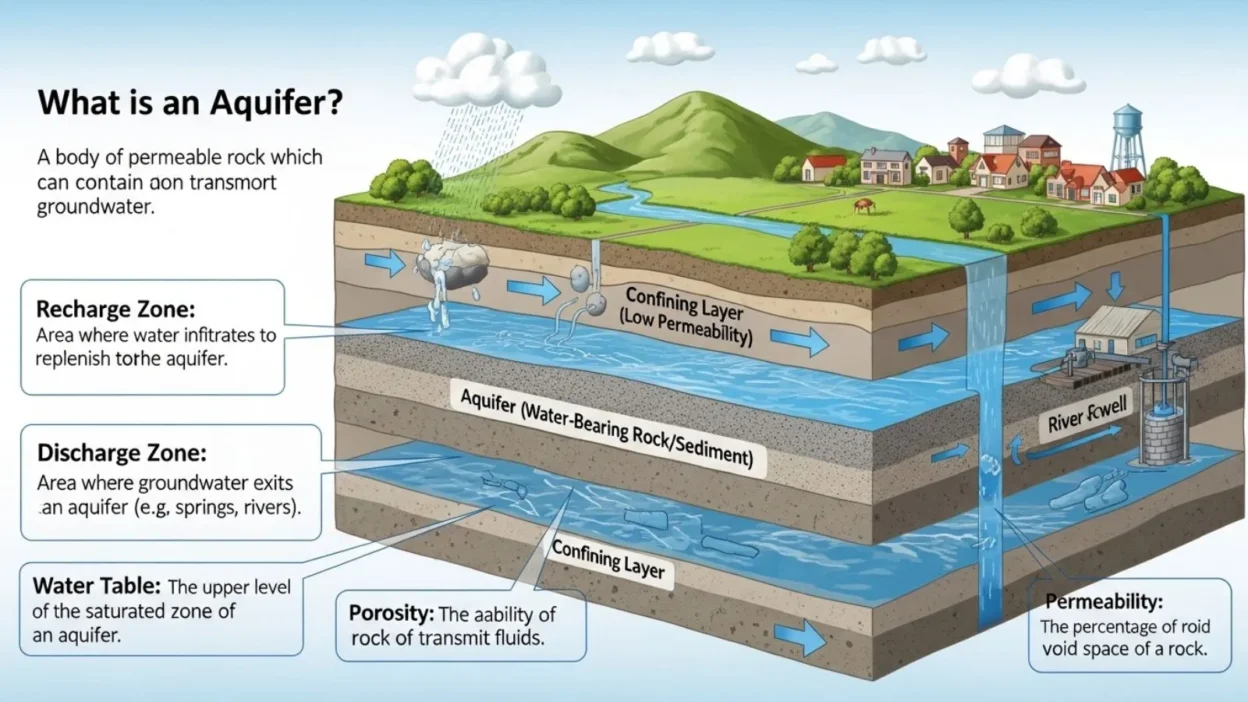
Water is one of the most vital resources on Earth, and much of it is hidden beneath our feet.
Understanding the aquifer meaning is essential for anyone interested in water conservation, agriculture, or environmental science.
Simply put, an aquifer is a natural underground layer of rock, sand, or gravel that holds and transmits water, acting as a reservoir for groundwater. These hidden water sources supply millions of people around the world with drinking water, support irrigation for crops, and sustain ecosystems like rivers and wetlands.
Aquifers come in different types, such as confined, unconfined, and perched, each with unique characteristics and importance.
In today’s world, where water scarcity and pollution are growing concerns, knowing how aquifers work and why they matter is more critical than ever.
This article will explore the definition, types, significance, threats, and ways to protect aquifers, giving you a complete understanding of these underground lifelines.
What is an Aquifer?
An aquifer is a natural underground formation that stores and transmits water through layers of permeable rock, sand, or gravel. Essentially, it acts like a sponge beneath the Earth’s surface, holding water in spaces between particles and allowing it to flow slowly over time. Understanding the aquifer meaning helps us appreciate how vital these underground reservoirs are for human survival and ecological balance.
Aquifers form in areas where the ground contains porous materials, such as sandstone, limestone, or unconsolidated sediments, which allow water to seep in and accumulate. The water in an aquifer comes primarily from precipitation, rivers, and surface water that infiltrates the soil—a process known as recharge. Once stored, this groundwater can move slowly through the aquifer, emerging naturally in springs or being accessed via wells for drinking water, agriculture, and industry.
The water table, which represents the upper surface of saturated ground, is closely related to aquifers. In unconfined aquifers, the water table rises and falls depending on rainfall and usage, while in confined aquifers, water is trapped between impermeable layers and is under pressure.
Aquifers are crucial because they act as natural water storage systems, providing a consistent supply even during dry periods. By understanding the aquifer meaning and how these underground reservoirs function, we gain insight into the sustainable management of one of Earth’s most valuable resources: groundwater.
Types of Aquifers
Aquifers are not all the same—they can be classified based on how they store and transmit water. Understanding the different types of aquifers is essential to fully grasp the aquifer meaning and how groundwater systems work.
1. Unconfined Aquifers
Unconfined aquifers are directly open to the surface, meaning water can easily seep down from rainfall or rivers. The top of this type of aquifer is called the water table, which rises or falls depending on how much water is replenished and withdrawn. Because they are more exposed, unconfined aquifers are easier to recharge but can also be more vulnerable to pollution from surface contaminants.
2. Confined Aquifers
Confined aquifers lie beneath impermeable layers of rock or clay, which trap water under pressure. These aquifers are often deeper than unconfined ones, and wells tapping into them can produce water that rises naturally without pumping, known as artesian wells. Confined aquifers are less susceptible to surface contamination, but they recharge more slowly, making them sensitive to over-extraction.
3. Perched Aquifers
Perched aquifers are small, isolated water pockets found above the main water table, separated by an impermeable layer. They form when water is trapped in higher ground and do not connect with larger aquifers. While limited in size, perched aquifers can provide localized water sources for small communities or ecosystems.
Each type of aquifer plays a unique role in water storage and supply. By understanding the types of aquifers, we can better manage groundwater resources, ensure sustainable water use, and protect these vital underground reservoirs from depletion and contamination.
How Aquifers Work
Aquifers function as natural underground reservoirs, storing and transmitting water through porous rocks, sand, and gravel. Understanding how aquifers work is key to grasping the full aquifer meaning and their importance in supporting life, agriculture, and industry.
Water enters an aquifer through a process called recharge, which occurs when rainfall, rivers, or surface water seeps into the soil and permeable rock layers. The water moves downward, filling the spaces between soil particles and cracks in rocks, gradually replenishing the aquifer. Recharge zones, often located in higher terrain, are critical areas where aquifers gain most of their water.
Once water is stored underground, it moves slowly through the aquifer due to gravity and pressure differences, eventually reaching discharge zones. These are points where groundwater emerges naturally at the surface, such as springs, rivers, or wetlands, or is extracted through wells for human use.
The water table represents the upper level of groundwater in unconfined aquifers, while confined aquifers are under pressure between impermeable layers. This movement and storage system ensures that aquifers can supply water even during dry periods, acting as a natural buffer against drought.
Human activities, like excessive pumping or pollution, can disrupt how aquifers work, reducing recharge rates and contaminating groundwater. By understanding the mechanics of aquifers—recharge, storage, and discharge—we can manage these vital water resources sustainably, ensuring long-term availability for communities, agriculture, and ecosystems worldwide.
Importance of Aquifers
Aquifers are one of the most critical natural resources on Earth, playing a central role in supplying water for human, agricultural, and environmental needs. Understanding the aquifer meaning highlights why these underground reservoirs are indispensable for daily life and long-term sustainability.
One of the primary functions of aquifers is providing drinking water. Millions of people worldwide depend on groundwater extracted from aquifers for their homes, schools, and businesses. In many rural and urban areas, aquifers are the most reliable source of potable water, especially where surface water is scarce or seasonal.
Aquifers also support agriculture and irrigation. Farmers rely on groundwater to water crops, particularly in dry regions or during periods of drought. Without aquifers, crop production would become far less predictable, impacting food security globally.
Beyond human use, aquifers maintain ecosystems and natural habitats. Springs, rivers, and wetlands are often fed by groundwater, which sustains plant and animal life even during dry periods. Industrial activities also benefit from aquifers, as water is essential for cooling, processing, and manufacturing.
Finally, aquifers act as natural buffers against droughts and climate variability, storing water during wet periods and slowly releasing it over time. This capacity ensures that both humans and nature have access to water year-round.
Protecting and managing aquifers is therefore not just about securing water for today, but about safeguarding future generations and maintaining ecological balance. By appreciating their importance, we can better understand why sustainable use and conservation of these underground reservoirs are essential.
Examples of Famous Aquifers
Aquifers exist all over the world, supplying water to millions of people and sustaining ecosystems. Some aquifers are particularly large or historically significant, making them excellent examples to understand the aquifer meaning in a global context.
One of the most well-known aquifers is the Ogallala Aquifer in North America. Stretching across eight U.S. states, it provides water for agriculture, industry, and domestic use. This aquifer is essential for the production of food in the Great Plains, supporting crops like wheat, corn, and soybeans. However, over-extraction has caused water levels to decline, highlighting the need for sustainable management.
In Australia, the Great Artesian Basin is one of the largest and deepest confined aquifers in the world. It spans over 1.7 million square kilometers and supplies water to remote communities and farms in arid regions. Its water is under pressure, allowing wells to flow naturally, making it a critical resource for survival in otherwise dry areas.
Africa is home to the Nubian Sandstone Aquifer System, one of the largest fossil aquifers globally. It spans several countries in the Sahara Desert, providing vital groundwater in regions where surface water is scarce.
Smaller local aquifers, though less famous, are equally important for regional water supply and ecosystems. From urban wells to rural springs, aquifers of all sizes play a vital role in maintaining water security and supporting human and environmental needs.
These examples show the diversity of aquifers and their critical role in sustaining life, emphasizing why understanding the aquifer meaning is so important worldwide.
Threats to Aquifers
While aquifers are vital for sustaining life, they face numerous threats that can compromise their quality and availability. Understanding these risks is essential for protecting these underground reservoirs and highlights the critical importance of the aquifer meaning in today’s world.
One of the biggest threats is over-extraction. Excessive pumping of groundwater for drinking, irrigation, and industrial use can lower water levels, causing wells to dry up and reducing water available for ecosystems. Over time, this can lead to long-term depletion, especially in areas where recharge is slow.
Pollution is another major concern. Chemicals from agriculture, such as fertilizers and pesticides, can seep into unconfined aquifers. Industrial waste, sewage, and oil spills can also contaminate groundwater. Once polluted, aquifer water becomes unsafe for human consumption and difficult to clean.
Urbanization and land-use changes further threaten aquifers by increasing impermeable surfaces, which reduce natural recharge from rainfall. Climate change also impacts aquifers by altering precipitation patterns and increasing the frequency of droughts, limiting the replenishment of groundwater.
Finally, saltwater intrusion can occur in coastal aquifers, where over-pumping allows seawater to mix with freshwater, making it unsuitable for consumption.
These threats demonstrate that aquifers are not unlimited resources. By understanding the aquifer meaning and the risks they face, governments, communities, and individuals can take measures to reduce stress, prevent contamination, and ensure sustainable use for future generations. Protecting aquifers is essential to maintain water security, agriculture, and environmental health worldwide.
Methods to Protect and Sustain Aquifers
Protecting aquifers is essential to ensure a reliable supply of clean groundwater for people, agriculture, and ecosystems. Understanding the aquifer meaning not only explains how these underground reservoirs work but also emphasizes the importance of sustainable management practices.
One of the most effective ways to protect aquifers is sustainable water use. This includes regulating groundwater extraction through well permits, promoting water-saving technologies, and encouraging efficient irrigation practices in agriculture. Reducing over-pumping helps maintain water levels and prevents depletion.
Artificial recharge is another strategy. Techniques such as rainwater harvesting, recharge wells, and infiltration basins allow water to seep back into the ground, replenishing aquifers naturally. Urban planners can also design green spaces and permeable surfaces to increase groundwater recharge in cities.
Preventing pollution is equally important. Limiting the use of harmful chemicals, properly managing industrial waste, and ensuring safe sewage disposal reduce the risk of contaminating aquifers. Communities can establish buffer zones around recharge areas to protect water quality.
Education and community awareness programs are also vital. When people understand the aquifer meaning and the role these reservoirs play in daily life, they are more likely to adopt practices that protect groundwater.
Finally, government policies and monitoring play a critical role. Regulations on water usage, pollution control, and aquifer mapping ensure long-term sustainability. By combining these methods—conservation, recharge, pollution prevention, and policy—society can protect aquifers and secure groundwater resources for current and future generations.
Aquifers and Human Society
Aquifers have been vital to human civilization for thousands of years, providing reliable water sources that support communities, agriculture, and industry. Understanding the aquifer meaning highlights how these underground reservoirs have shaped societies historically and continue to influence modern life.
Historically, human settlements often developed near natural springs or regions with abundant groundwater, which later connected to aquifers. Civilizations like the Egyptians, Mesopotamians, and Indus Valley inhabitants relied on wells tapping into aquifers to irrigate crops and supply drinking water. Without these underground water sources, large-scale settlements and agriculture would have been nearly impossible in arid or semi-arid regions.
In modern society, aquifers remain essential. Urban populations depend on groundwater for household use, while farmers rely on aquifers for irrigation, especially in regions with limited rainfall or surface water. Industries use groundwater for manufacturing, cooling, and processing, making aquifers an integral part of the economy.
Beyond human use, aquifers support ecosystems by feeding rivers, lakes, and wetlands, maintaining biodiversity even during dry periods. They act as natural buffers against droughts and water scarcity, helping communities survive extreme weather events.
However, human activities such as over-extraction, pollution, and urban development have put pressure on aquifers worldwide. Recognizing the importance of aquifers and their role in human society emphasizes the need for sustainable management. Protecting these underground water sources ensures that they continue to support communities, agriculture, industry, and ecosystems for generations to come.
FAQs About Aquifers
1. What is the difference between an aquifer and the water table?
An aquifer is the underground layer of rock, sand, or gravel that stores and transmits water, while the water table is the upper surface of the saturated ground in an unconfined aquifer. Essentially, the water table marks the top of the aquifer’s water.
2. Can aquifers run dry?
Yes, aquifers can deplete if water is withdrawn faster than it is naturally replenished. Over-extraction, droughts, and climate change can all lead to lowered water levels, which may take decades to recover.
3. How are aquifers formed?
Aquifers form in porous and permeable materials like sandstone, gravel, or limestone. Water enters these layers through recharge zones, filling the spaces between particles and creating a natural underground reservoir.
4. How deep are aquifers usually?
The depth of aquifers varies. Some are shallow, just a few meters below the surface, while others, like confined aquifers, can be hundreds of meters deep. Depth depends on geology and regional water table levels.
5. How are aquifers protected from pollution?
Protection involves sustainable water use, reducing chemical runoff, proper waste disposal, and monitoring recharge zones. Urban planning, conservation practices, and regulations also play critical roles in maintaining groundwater quality.
Conclusion
Aquifers are essential underground reservoirs that play a vital role in sustaining life, agriculture, and ecosystems.
Understanding the aquifer meaning helps us recognize how these natural formations store and transmit groundwater, supply drinking water, support irrigation, and maintain ecological balance.
There are different types of aquifers unconfined, confined, and perched each with unique characteristics and importance. Aquifers face numerous threats, including over-extraction, pollution, and climate change, which can compromise water availability and quality.
Protecting and sustainably managing these resources is critical for ensuring long-term water security. By adopting practices like efficient water use, artificial recharge, pollution prevention, and community awareness, we can safeguard aquifers for future generations.

Jonathan Bishopson is the punmaster-in-chief at ThinkPun.com, where wordplay meets wit and every phrase gets a clever twist. Known for turning ordinary language into laugh-out-loud lines, Jonathan crafts puns that make readers groan, grin, and think twice. When he’s not busy bending words, he’s probably plotting his next “pun-derful” masterpiece or proving that humor really is the best re-word.